Contact
Elise Risher
Director
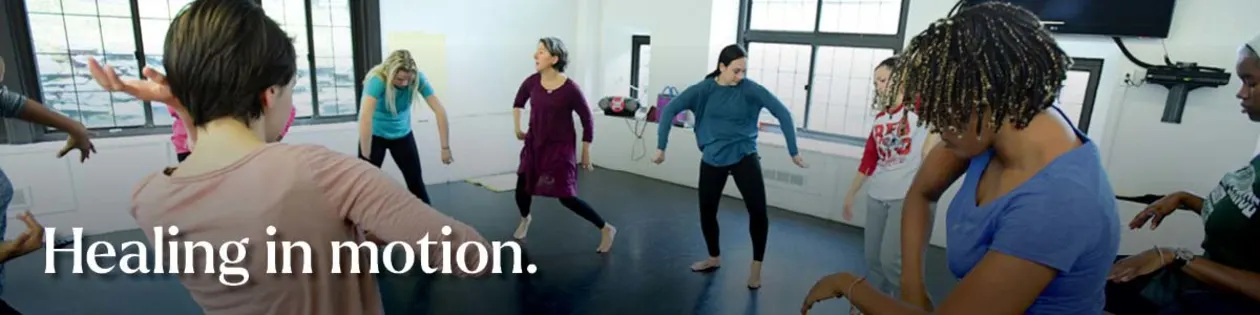
Using an embodied, process-oriented approach to learning, the Sarah Lawrence Dance/Movement Therapy program is a 2-year Master’s degree that invites you to engage in critical thinking about the body, movement, and relationships. You will learn a way of thinking and being in the world that promotes interpersonal sensitivity, cultural dexterity, and an ability to effect change through listening, understanding, and engaging the whole being.
Why pursue your training in Dance/Movement Therapy at Sarah Lawrence College?
- We are one of only seven programs in the country approved by the American Dance Therapy Association to provide Masters level training in Dance/Movement Therapy
- You can take full advantage of the College’s proximity to New York City and our connections to its vibrant dance and dance/movement therapy communities.
- Small class size on an intimate campus allow for personalized attention and development of the whole person
- The program’s focus on social justice is also reflected in the larger college community
- This degree prepares you to take the New York State licensing exam for creative arts therapists and to receive the R-DMT credential from the American Dance Therapy Association (ADTA) upon graduation.
Program & Requirements
-
The Dance/Movement Therapy program:
- Blends theoretical perspectives and practical fieldwork
- Integrates the historical, developmental, cultural, and clinical aspects of dance's ability to heal and promote change
- Empowers students to explore their own relationships with dance from the perspective of personal growth, reflective use of self, and social action
- Enables students to develop and integrate their own movement abilities using their cognitive, emotional, and social resources as a means of building connections with their clients and facilitating growth and change
- Permits students to engage with professionals from the Dance, Psychology, Child Development, and Art of Teaching programs
- Provides a setting for ongoing research and innovation among established practitioners
-
The M.S. degree in Dance/Movement Therapy can be completed on a full-time basis in two years. The program’s structure does not allow for part-time study.
Program requirements include:
- Completion of 60 credits.
- Clinical internships totaling 700 hours, with at least 350 hours of direct client contact. Internship placements include therapeutic preschools or community programs, elementary or secondary schools, or child-life programs on pediatric wards, adult psychiatric hospitals, rehabilitation facilities, and nursing homes.
- Clinical fieldwork, which provides opportunities for observation, research, and practicum experience. First-year placements are at a local early childhood center which allows students to study typically developing children from ages two through six.
- Master’s thesis, during the program’s second year.
-
Classes are scheduled to meet two days per week, with fieldwork and internships occurring on non-class days. Students will need to have flexible schedules in order to meet fieldwork and internship requirements.
Courses involve movement participation and/or experiential exercises in a seminar format with class discussions. Verbal and movement participation are expected of all students.
Year One, Fall Semester
- Graduate Seminar in Methods and Theory of Dance/Movement Therapy I (3 credits)
- Movement Observation I (3 credits)
- Human Growth and Development (3 credits)
- Group Work: Theory and Practice I (3 credits)
- Professional Orientation and Ethics (3 credits)
- Anatomy & Kinesiology (1 credit)
- Fieldwork (1 credit)
Year One, Spring Semester
- Graduate Seminar in Methods and Theory of Dance/Movement Therapy II (3 credits)
- Movement Observation II (3 credits)
- Psychopathology (3 credits)
- Group Work: Theory and Practice II (3 credits)
- Clinical Fieldwork Orientation (3 credits)
- Research Methods (3 credits)
- Fieldwork (1 credit)
Year Two, Fall Semester
- Graduate Seminar in Methods and Theory of Dance/Movement Therapy III (3 credits)
- Movement Observation III (3 credits)
- Clinical Internship (2 credits)
- Clinical Internship Practicum I (1 credit)
- Clinical Treatment Planning (3 credits)
- Graduate Thesis Advising I (2 credits)
Year Two, Spring Semester
- Graduate Seminar in Methods and Theory of Dance/Movement Therapy IV (3 credits)
- Clinical Internship II (2 credits)
- Clinical Internship Practicum II (1 credit)
- Graduate Thesis Advising II (2 credits)
- Thesis (2 credits)
-
A strong background in dance is essential. Students should demonstrate concentrated study in a classic, contemporary, or world dance form and some experience in at least one other dance style or a body-mind modality such as yoga. Proficiency in basic elements of dance, such as improvisation, choreography, and teaching, is also preferred.
Interest and experience in working with and helping others are also important. Applicants should be self-reflective and respectful of individual differences, with a commitment to working as a therapist.
-
A graduate degree in dance/movement therapy from Sarah Lawrence College will prepare students for careers working in medical facilities, psychiatric hospitals, nursing homes, rehabilitation settings, residential programs, and schools, as well as many other clinical and educational settings. Advanced level DMTs also provide services in private practice.
Dance/Movement Therapy is eligible for licensure and third-party reimbursement in many states. The Sarah Lawrence program prepares graduates to take the New York State licensing examination for Creative Arts Therapists.
Sarah Lawrence College's Dance/Movement Therapy Program is approved by the American Dance Therapy Association. DMT Graduate Programs that meet the requirements stated in the ADTA Standards for Graduate Dance/Movement Therapy Programs satisfy all professional requirements for the Registered Dance/Movement Therapist (R-DMT) credential.
-
Professional Licensure Disclosure
The Sarah Lawrence College Dance/Movement Therapy program is accredited by the American Dance Therapy Association (ADTA) as an approved program through June 2031. Upon completion, students are awarded a Master of Science (MS) in Dance/Movement Therapy and graduates are automatically eligible to apply for the R-DMT (Registered Dance/Movement Therapist) credential upon graduation. After accumulating paid working hours and attending to other requirements, graduates may apply for the BC-DMT (Board Certified Dance/Movement Therapist), which enables them to conduct a private practice.
The program is registered with the New York State Education Department (NYSED) as a licensure-qualifying program in Creative Arts Therapy, meeting the educational requirements for the LCAT (Licensed Creative Arts Therapist) in New York State. Because the LCAT credential is unique to New York State, the program does not meet the state educational requirements for licensure as a Creative Arts Therapist in any other state or territory.
(NYSED) as a licensure approved program and is accredited by the American Dance Therapy Association as an approved program through June 2025.
New York State licensure as a Creative Arts Therapist (CAT) is available after 1,500 hours of approved clinical work under the limited permit, and is granted after successful completion of the licensing exam. Graduates of the program who choose to pursue employment in New York State after graduation can apply for a limited permit, which is the first step toward licensure.
There are varied pathways to licensure for mental health professionals. Some creative arts therapists practice under other licenses, such as Licensed Professional Counselor, Licensed Mental Health Counselor, Licensed Marriage and Family Therapist, or similar. Students who intend to work outside of New York State and/or intend to seek licensure under a different credential than the LCAT should contact the Program Director, Elise Risher (erisher@sarahlawrence.edu) to discuss whether the program meets educational requirements for that specific license in their intended state of employment.
-
The Caldwell Dance Studio is located in the bottom floor of the MacCracken Dorm, adjacent to the MacCracken Dance Studio. This studio has large windows, a Marley floor, mirrors with curtains, and foldable tumbling mats. While Caldwell Dance Studio is primarily used by the Dance/Movement Therapy program for class, the Dance Program’s MFA students also use this space for their group rehearsals.
MacCracken Meeting Room is located on the first floor of the MacCracken Building , adjacent to the Dance/Movement Therapy offices and nearby the MacCracken and Caldwell Dance Studio. This space allows students to gather for seminar classes, meetings, and both formal and informal gatherings.
The Early Childhood Center - founded in 1937, the Early Childhood Center (ECC) at Sarah Lawrence College was among the first college laboratory schools in the United States. It serves as a community school for children ages 2 to 6, drawing families from 15 local school districts. It provides an environment for students and faculty from Sarah Lawrence and other institutions to engage in fieldwork and student teaching.