Meet the Associate Director
Meet XiaoChuan Xie, Associate Director, Dance/Movement Therapy
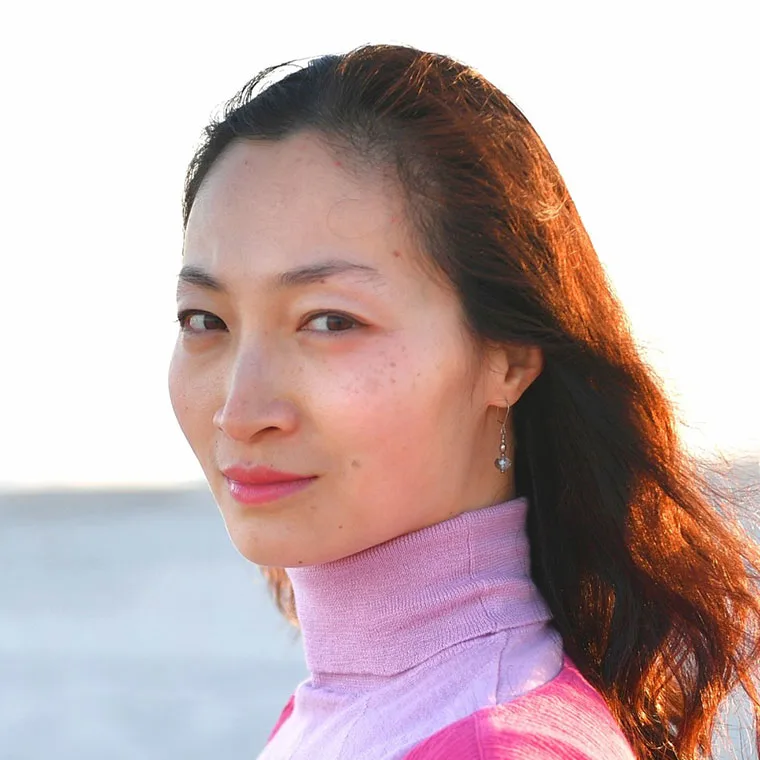
Background
Education
Chuan earned her BA from SUNY Empire College, her MS in Dance/Movement Therapy from Sarah Lawrence College, and her PhD from European Graduate School. She is a NYS licensed creative arts therapist and board-certified dance/movement therapist. She is certified in Laban/Bartenieff movement analysis. Chuan became Associate Director of Sarah Lawrence’s Dance/Movement Therapy program in 2023.
Clinical Work
Chuan’s clinical experience has been concentrated on long-term forensic psychiatric rehabilitation and psychosis treatment. Her clinical approach, Restorative Decentering, has been developed to help alleviate negative symptoms and immobilized trauma-responses.
Teaching Experience
Chuan began teaching in Sarah Lawrence’s Dance/Movement Therapy program in 2021. She was a guest lecturer at CUNY Hunter College and China Northwest Teachers’ College. Chuan is a regular Speaker at the Expressive Therapies Summit, and has presented at New York Presbyterian Weill Cornell’s psychiatric grand round lecture series.
Current Research
“Aesthetic Encounters on a Forensic Psychiatric Ward”, and “Freedom Dance in a Liminal Space”.
Movement-Based Expressive Arts Practice
As a dancer and interdisciplinary artist, Chuan is a Clive Barnes Award and Fred Astaire Award nominee for her excellent performance in the Martha Graham Dance Company and The King and I on Broadway. She continues to facilitate and produce community-based creative works advocating for a more inclusive and compassionate society.
Interests
Research Interests
Chuan is a narrative researcher who finds meaning through collecting and connecting fragments of the stories from people in the shadows. Her narratives focus on illuminating the intrinsic bonds between embodied arts, communal health, and arts-based health justice.
Personal Interests
Chuan enjoys dancing, singing, laughing, and daydreaming.
XiaoChuan Xie Answers Your Questions
How did you become interested in dancing?
I was trained to become a Red-Army dancer for the Chinese Liberation Army when I was ten years-old. I was instantly mesmerized by dancing on stage and thought it was the perfect hiding place for me. On stage, I had the freedom to be whoever I wanted to be.
What brought you to New York?
At one point, hiding on stage wasn’t enough for me anymore. I wanted to explore more possibilities for my dancing body. I went to see Martha Graham Dance Company’s Beijing debut in 2008, and was deeply moved by the war-themed ballet, Chronicle. I had never seen a group of women so powerful with their weighted steps. The mere thought that I wanted to become one of the dancing warriors moved me to New York to study the Graham technique.
What led you to study Dance/Movement Therapy and what made you choose the Sarah Lawrence program?
I experienced an eye injury when dancing with the Martha Graham Dance Company, and later a hip injury when I was performing in The King and I on Broadway. The latter hip injury brought me to many body-mind healing modalities (including dance/movement therapy), re-learning my body, developmental movement, and basic standing and walking. The process has led me to realize that helping others through my gift in dance feels like home.
After dancing professionally for thirteen years, I decided to transition into the field of dance/movement therapy. I chose the program at Sarah Lawrence College because of its emphasis in developmental approach. Personally, I was intrigued by the process of revisiting my early movement patterns, and wanted to learn more about it. Another major reason was that I felt connected to Elise Risher, Sue Orkand, and Alma Watkins during my interview for the program. It felt like the right place for me.
As a student in the program, what did you find most valuable?
It’s needless to say that the warm nurturing atmosphere that Elise and other faculty members created in the program is felt throughout my whole two-years study. The combination of first-year fieldwork and coursework was an eye-opening experience, allowing me to look back on my childhood and early relationships. The cohort-learning style and the small community of faculty and students helped me cultivate many meaningful relationships and also reconcile with some past relationships.
After graduating from the program, what did you do next?
During my second-year internship at Rockland Psychiatric Center, I was offered a full-time position as a dance/movement therapist on a forensic psychiatric ward. I spent the next three years working with forensic psychiatric patients, while obtaining my doctoral degree in Expressive Arts Therapy and Peacebuilding at the European Graduate School.
Now that you are back at Sarah Lawrence both teaching and helping to direct the program, what is your experience like?
This is another eye-opening experience, allowing me to work on the other side of the program. Many things I took for granted as a student are now my responsibilities to build and maintain. I do feel very fortunate to be able to help manage a program where I had a meaningful experience as a student. It feels like I am deepening the spirals of dance/movement therapy practice, from a student to a clinician, a supervisor, an educator, and an administrator.
Can you describe your philosophical approach to dance and dance/movement therapy? Someone described you as having a strong sense of community and giving voice to people who do not otherwise have an opportunity for expression. Can you talk more about this?
I truly believe in the existential power of moving with others in time and space. Whether the individual body’s choreography of breathing and heartbeating, or the communal body’s choreography of working and protesting, we are constantly dancing with each other and with natural elements. In dance/movement therapy, we meet our patients with our bodies. Nothing is bolder than that. Our bodies tell stories that are often buried beneath shame and trauma. Through dancing and moving with others in time and space, we not only reconcile with our own bodies, but also with other bodies.
Recently you taught a course called Dance and Restoration at the Bedford Hills Correctional Facility. Tell us about that experience.
I have had many eye-opening experiences at Sarah Lawrence, and teaching at the Bedford Hills combined program was one of them. I am going to quote one Bedford Hills student’s reflective poem here to summarise the experience:
“In Time, We Move”
By Leslie Finch
There was a silence
so heavy it bent my spine.
The weight of years, of names untrue,
of a child’s laughter
stilled too soon.
I entered the circle
not to dance
but to disappear.
Yet when the music began,
my heart betrayed me.
A pulse,
A tremor,
A remembering.
Arms lifted not in grace,
but in grief,
and still - they rose.
Feet found ground
that once felt foreign,
and time, that cruel warden,
softened its gaze.
We moved together,
each carrying our own wound,
each learning that rhythm
can be mercy.
And in that sway,
I felt her,
my Mila,
dancing in the quiet between beats.
Not gone.
Just moving
somewhere within the music.
Watch, Listen, Read
- Xie, X., Williams-Mulet, N.L. & Bernas, M.P.M. On Being Together: A Collective Reflection on a Dance/Movement Therapy Session in a Pediatric Hospital. Am J Dance Ther (2026). https://doi.org/10.1007/s10465-025-09425-3
- Xie, X. Restorative Decentering: Intermodal Expressive Arts in Long-Term Forensic Psychosocial Rehabilitation. J. Psychosoc. Rehabil. Ment. Health 12, 577–589 (2025). https://doi.org/10.1007/s40737-025-00491-x
- Xie, X. (2020). Reciprocal waves: embodied intersubjective communication in dance/movement therapy (DMT) practice. Body, Movement and Dance in Psychotherapy, 15(2), 90–105. https://doi.org/10.1080/17432979.2020.1746400
- Family-reunion dance film: Mountain, Water, the Sun, and the Moon by Xie family (2025).
- Self-contemplative dance film: Journey to the West by XiaoChuan Xie (2021).
- Group advocacy dance film: Together: Hope and Resiliency, a tribute to all mental health workers during the global pandemic (2020).