Meet the Director
Meet Elise Risher, Director of the Dance/Movement Therapy Program
One can convey a vast range of emotions with just the movement of the body. It’s totally magical. Even after doing it all this time, I’m often awestruck.
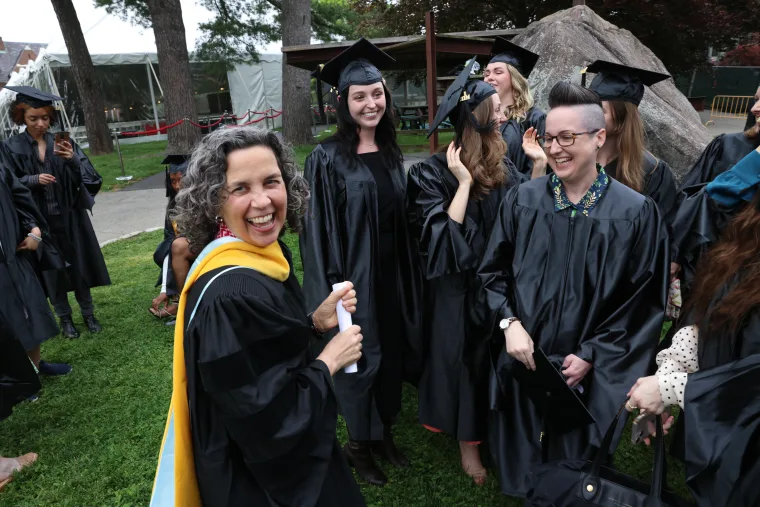
Background
Elise received her BA fromTrinity College, her MS from Hunter College and an MA, PhD from Long Island University. Elise is a board-certified dance/movement therapist and licensed clinical psychologist.
Elise began teaching in Sarah Lawrence College’s MS in Dance/Movement Therapy program in 2012 and became Director in 2016. Elise has also taught at Mercy College, Westchester Community College, Long Island University, and The New School.
Elise’s clinical experience includes working with infants, children, adults and elderly populations in both psychiatric and community settings.
Interests
Research Interests
Elise’s research interests include the impact of neurological disorders on time perception and the intersection of psychotherapy and Eastern philosophies.
Personal Interests
Dancing, puzzles, reading for pleasure, baking, gardening.
Elise Answers Your Questions
Excerpted from SLC podcast. Listen to the entire interview here.
How do you define dance/movement therapy?
Dance/movement therapy is the therapeutic use of movement to integrate body, mind, spirit, emotion, cognition. Dance is something that has existed forever. It has always been part of human experience and used for things like healing and community building. In Western culture generally, dance has been removed from everyday life. It has often been seen as performance and something that only trained people can do. In the 1940s and 50s, there were a number of people across the country, who were using dance as a form of psychotherapy. They were influenced by early psychological theories and psychoanalysis and they were finding that using movement, not as a performative process, but as an experiential process, helped in terms of making personal change, in terms of identifying feeling states. For people who had trouble articulating feelings, it helped with identifying and processing their experience. In 1966, the American Dance Therapy Association was formed, with the idea of training individuals in the use of movement as a therapeutic practice.
What kinds of therapy do dance/movement therapists incorporate into their practice?
Psychotherapy and psychological frameworks are a significant piece of it, and we work with people with all different diagnoses, but we also work with individuals with physical illness. We work in medical settings, psychiatric settings with adults, seniors, and with young children. With very young children, we can help to support developmental movement. There are dance/movement therapists who work with parents and young babies to help with their developmental processes. Its application is really very broad.
What was your earliest connection to dance?
I don't remember a time when I didn’t love to dance. When I was a kid, my mother would put on records in the house and we would dance around and have fun. And I remember, I was just telling my students this, we had a ballet book in the house that belonged to my older sister. And I used to love to look at the drawings. I begged my mother to send me to classes. My experiences in formal dance training were maybe not always as joyous, as I didn’t always feel as connected to movement in the same way. So I kind of had a reluctant connection to them.
I had a wonderful dance teacher when I was a child, and there was a lot of joy to it. But as I moved into adolescence, my teacher moved away. And so I started with a new teacher. My body was changing at the time. And sometimes, and our students have talked about this, sometimes dance training is about putting you into a particular form. It doesn’t necessarily respect your own body, but kind of wants your body to match the ideal of a particular dance technique or choreographer. Not all dance training does that, but certainly many people have shared that experience of not feeling like their own experience of movement was respected in the dance class setting. And I bumped up against some of that. It felt very focused on a particular kind of technique, a particular kind of look, and never fully tapped into my own movement experience or my own joy in dance. And so I stepped away from it for a while because what drew me to it was that feeling of joy, that feeling of dancing alone when nobody was looking.
As you got older, how did your connection with dance change?
When I went to college, I became more involved in modern dance and improvisation and exploring those techniques. But really my love for dance has been a body-based experiential process. So much more than something outside of myself. Like, oh, look at that. I want to see that. People often talk about the kind of visceral experience that we have with dance. I used to love to go to performances and kind of feel myself on stage, doing the leaps or doing the turns. And that’s sort of a profound piece of what we do, because a lot of it’s about going internally and discovering who you are, but a lot of it is about making connections with someone else.
What led you to pursue dance/movement therapy?
I first learned about dance/movement therapy in college, when I was exploring dance improvisation and Buddhist philosophy. I was part of the inaugural Trinity College La MaMa Performing Arts Program class of 1986. Trinity/La MaMa is a unique performing arts program, immersing students in the cutting-edge theater and dance scene of New York City. It is the only one of its kind in the nation. I wasn’t quite sure what I wanted to do in theater and dance but this program exposed me to all kinds of performances, conversations and people and an understanding of the range of possibilities. Through that program, I interned at the Laban Institute and was exposed to people who were doing different types of bodywork as well as dance/movement therapy.
What do you like most about being a dance/movement therapist?
One can convey a vast range of emotions with just the movement of the body. It’s totally magical. Even after doing it all this time, I’m often awestruck. For example, when you work in a hospital setting with people who have real difficulty with organizing thoughts or expressing inner emotions, or people who have experienced trauma that maybe has kind of closed them off in a particular way. And to move with them, and to see them feel something that maybe they haven’t felt before, to have a memory come up that they haven’t thought about in forever, and to have that bring them some kind of comfort or insight. All of that is here in our body, and what I love about that is, it’s always accessible to us. Oftentimes, I'll be feeling a particular way and not quite know what it is, and I'll just close my door and move, and oh, it becomes much clearer to me.
Why should someone choose to study dance/movement therapy at Sarah Lawrence?
Sarah Lawrence’s program is one of seven graduate programs across the country approved by the American Dance Therapy Association. The culture of Sarah Lawrence College is one that fosters a deep inquiry, not just intellectually, but experientially. Our students are challenged to grow in so many ways, all in an intimate and supportive environment.
What kind of classes do students take?
Our students take what's known as Graduate Seminar. Graduate Seminar really looks at the history of dance, looks at the history of dance/movement therapy. It looks at working with different populations and in different configurations if you will. What does it mean to work individually with someone? What does it mean to work with groups? Those classes are really lab classes. They meet in the dance studio, students come in and have their own movement experiences together. Maybe as the program progresses, students will lead one another in a group process. Then there's discussion about that. What just happened here? What did we notice in our bodies? What did we notice happening with the group? Then maybe some discussion about the history that we're learning about that day, or the particular theorists that we're learning about as it relates to the work we just did.
There are three semesters of what we call movement observation. When we look at people moving, we may have biases toward particular kinds of movement, right? Something captures your attention, but at the same time that something captures your attention, there are also probably kinds of movement that maybe you ignore, or maybe you're not so tuned into. So movement observation gives us several different systems for looking at movement, naming it, and understanding how different movements relate to one another, and using that for intervention.
Then students have courses in ethics and professional development, courses in psychopathology, courses in human development. They have two semesters of what we call group work theory and practice. So they're learning about how group psychotherapy happens, how groups unfold generally, and they're also having a group experience. So a lot of what we really believe is that learning about the self happens in a community. So our students all go through the program together. They're a cohort. They do all of these things together. They're learning about themselves and who they are as movers, who they are as part of a group, who they are as observers, and doing it with one another as their support and connection in this.
Students also write a thesis, and at the end of the second year, our students do thesis presentations, which are always really exciting because they cover the gamut of how dance therapy might be applied.
Students also do fieldwork. They do fieldwork in their first year, in an early childhood setting. They run a group with kids from our Early Childhood Center. Then in the second year, they do internships in Westchester and New York City. So it really is about giving them as complete an experience of dance movement/therapy as possible.
What kinds of jobs are available to people with a degree in Dance/Movement Therapy?
Anywhere you can think of, probably dance/movement therapy would be applicable. Typically, our recent graduates are working in hospital settings. There's a licensure process in New York state and in many other states. That requires that people work in hospital settings or in nursing home settings. So graduates are working in inpatient psychiatric, inpatient medical, outpatient community health centers, nursing homes, assisted living facilities, charter schools, schools for kids with all sorts of developmental challenges, community centers and carceral settings.
Why would someone want to become a dance/movement therapist?
I always say I'm so lucky to do this work. Working in health care settings is really challenging, and people are bringing very challenging experiences. But as a dancer, and for our students who come in who are dancers, and who say, you know, I really want to continue this work, but I also have this pull toward serving others and helping others. I also have a pull toward intellectual exploration. And dance/movement therapy really is multidisciplinary. It requires you to show up fully in your work every day. It's not a boring job, I will definitely say that. It is definitely cool because it accesses so much of who we are on a daily basis.
What is your advice for people who are not involved in the world of dance/movement therapy?
If there's one thing I say, more people should dance. And the idea that dance is limited to people who can dance or people who are trained in dance is really, I think, quite a loss because that expression of ourselves is what makes us whole and full. It also gives you a tool kit for dealing with your thoughts, emotions, and spirituality. If dance is not in there, you're missing a pretty important tool. When you move you immediately change your thought process. You're creating a new avenue for understanding what these feelings are and you can better understand yourself as a result. All of us can dance. If you have a heartbeat, you've got a rhythm section right there. Any breath is movement, and exploring that and giving life to that is really this incredible creative process.
Watch, Listen, Read
- The Sarah Lawrence College Podcast - EP29 - Dance Movement Therapy with Elise Risher
- What is Dance/Movement Therapy and is it Right for You? This recorded information session (held virtually this past September) is intended for those wishing to explore the field of dance/movement therapy as a possible career pathway
- Elise Risher was part of the inaugural Trinity La MaMa Performing Arts Program class of 1986. Hear Elise talk about her experience in the program and her journey in the career of Dance/Movement Therapy in their Life as an Artist series! https://www.facebook.com/watch/?v=467631217408959