Sarah Lawrence College

About SLC

The President's House: A History in Photos

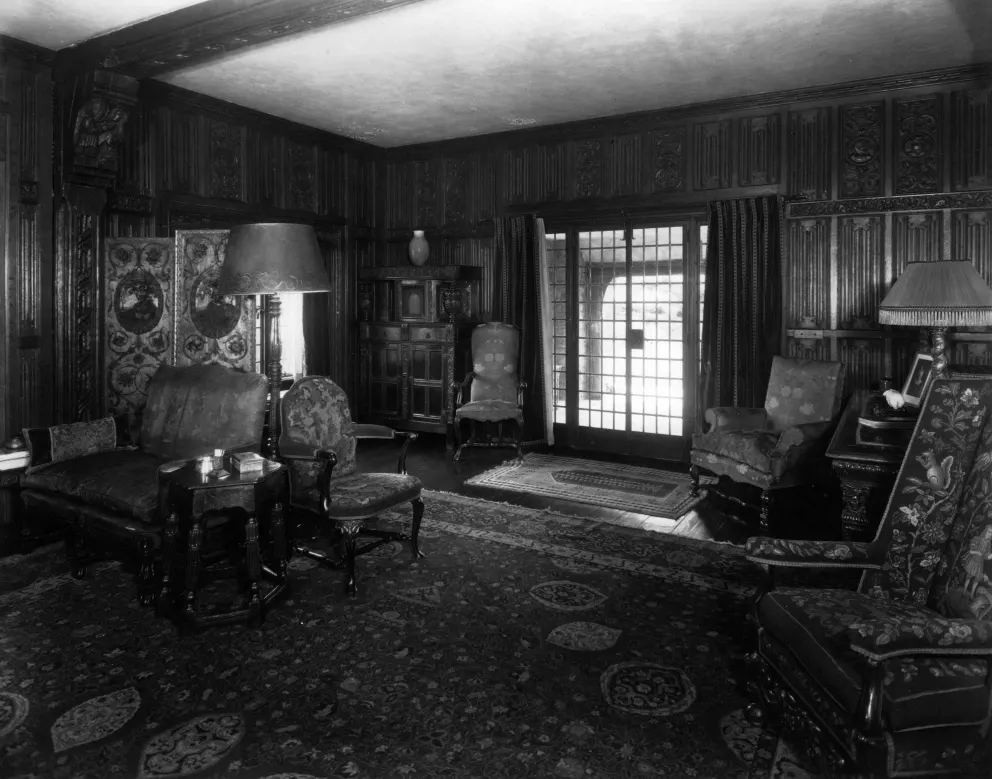
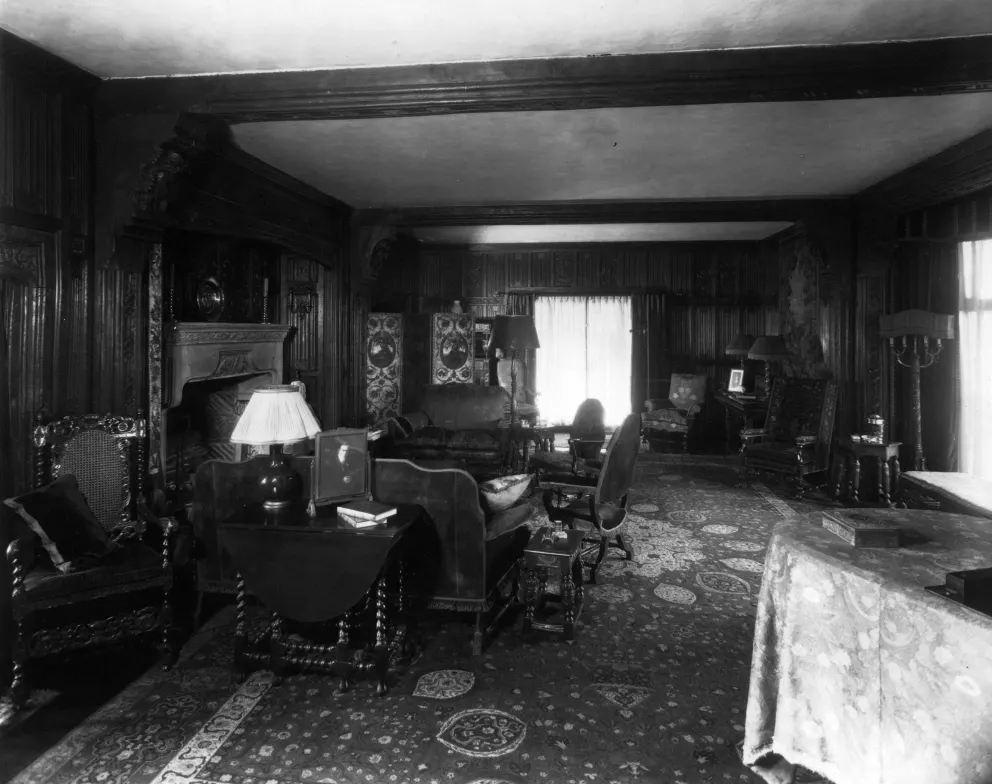
Vintage room with wooden paneling, ornate furniture, and patterned rugs.
The exposed beams are braced by carvings that represent various trades and crafts, such as that of the wood chopper.
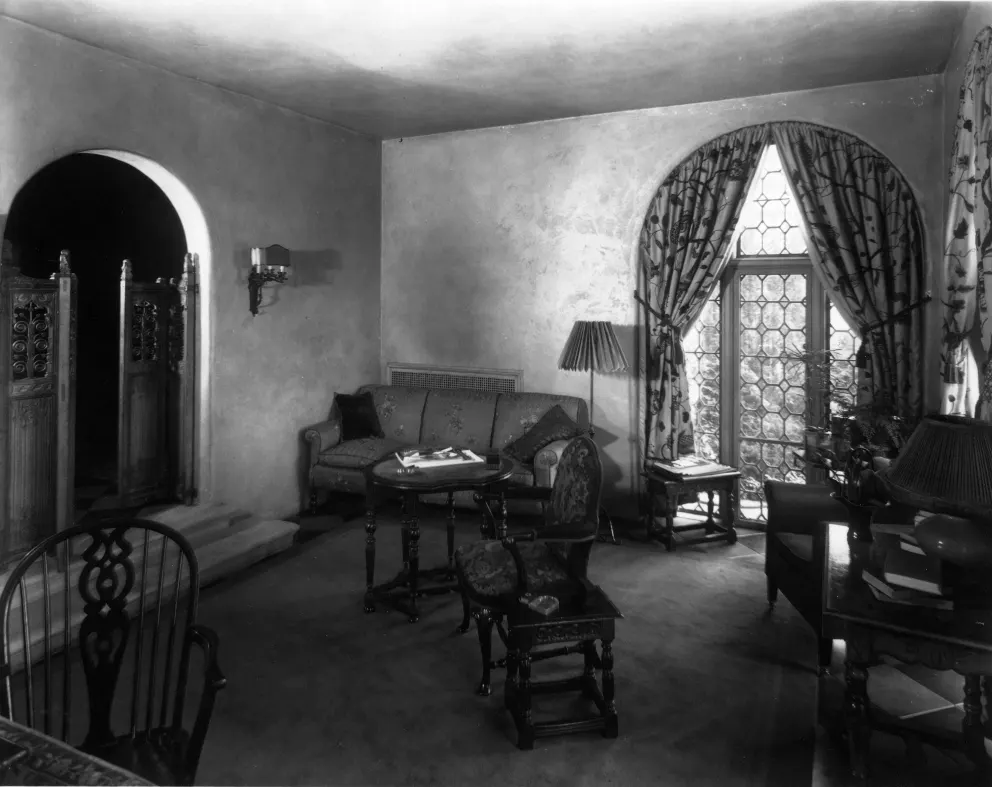
Vintage room with furniture, arched doorway, and patterned window curtains.
Library
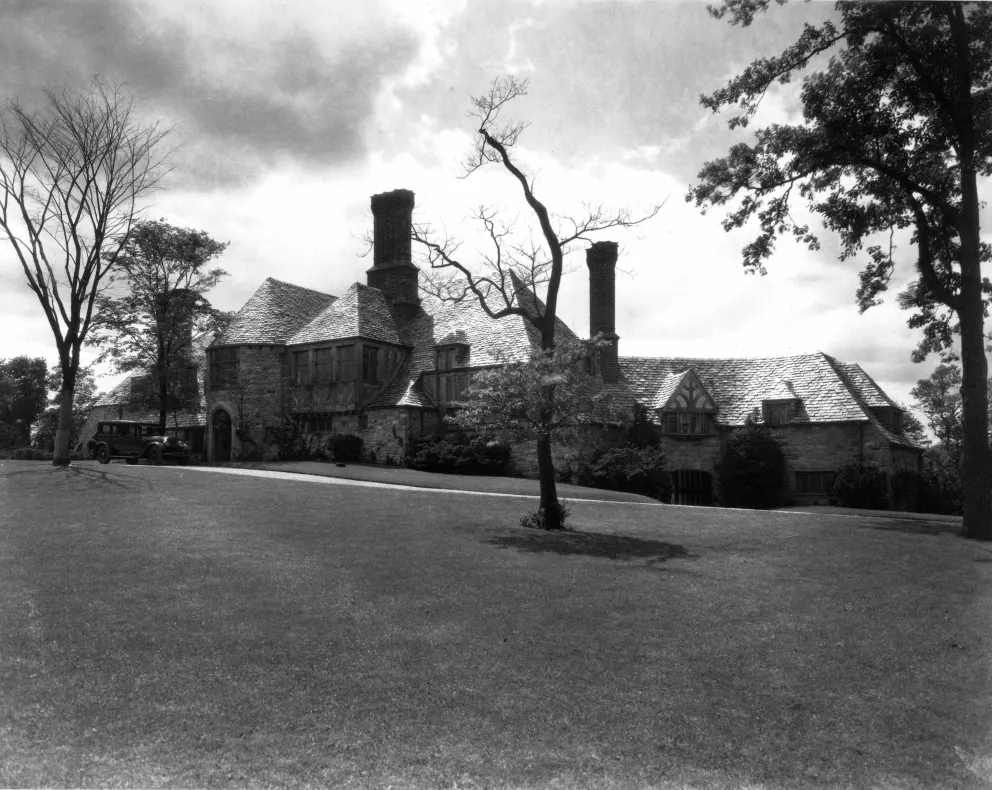
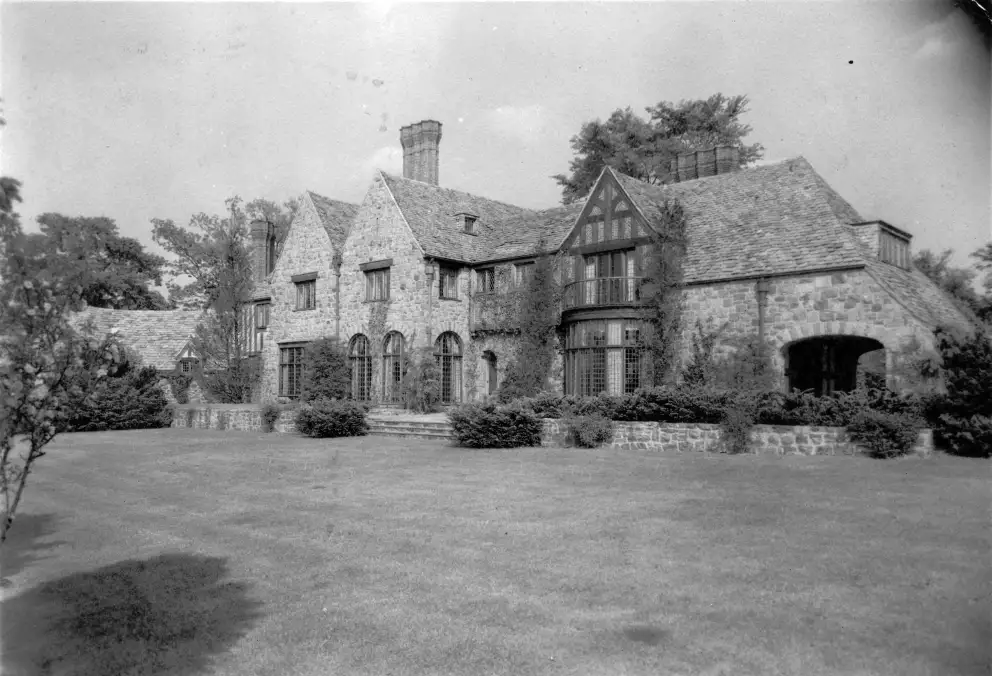
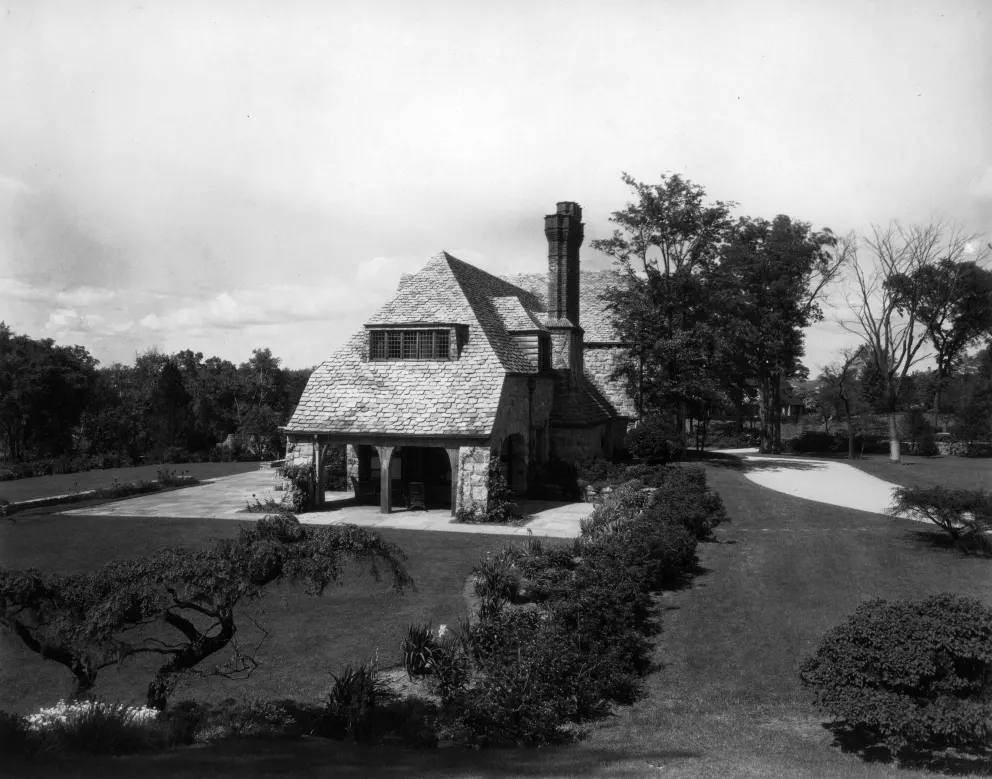
Large stone house with tall chimneys surrounded by trees and lawn.
All photos circa 1925, courtesy of the Sarah Lawrence Archives
Vintage photo of a traditional stone house with multiple chimneys and a thatched roof.
As so often is true of Bowman houses, the building is sited attractively on a slight rise and rests snugly against the earth as though it has always been there.
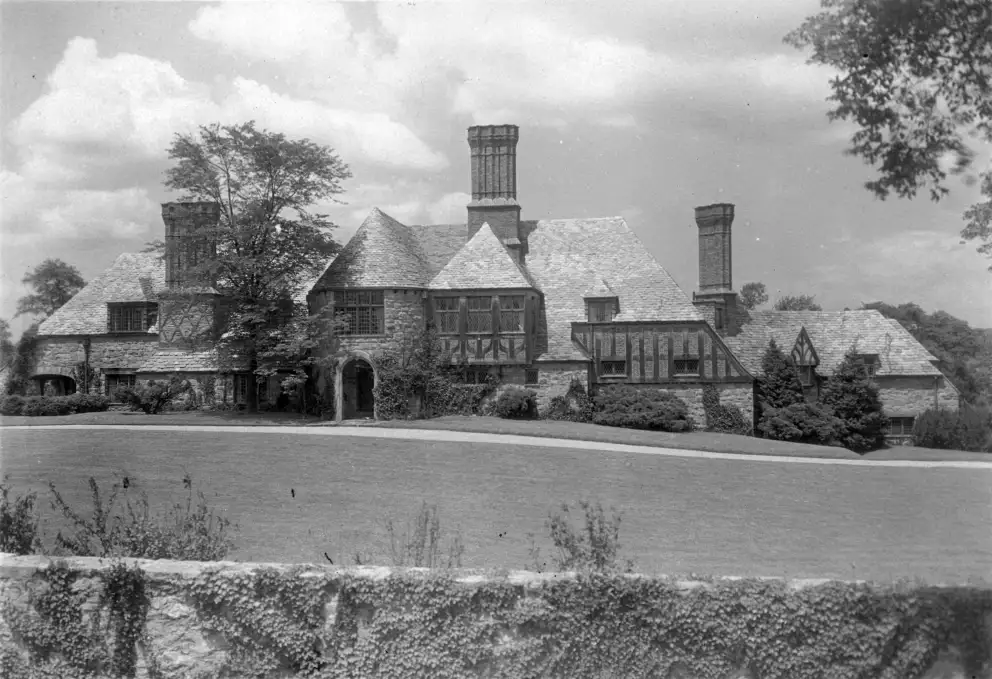
Vintage black and white photo of a large stone house with a garden.
The house is of an arresting design that evokes the romance of medieval times. The turreted entrance, the steeply sloped slate roof, the touches of tapestry brick and half-timbering, and the elaborate chimneys are laced together in a harmonious whole by the deft talents of the master, Lewis Bowman.
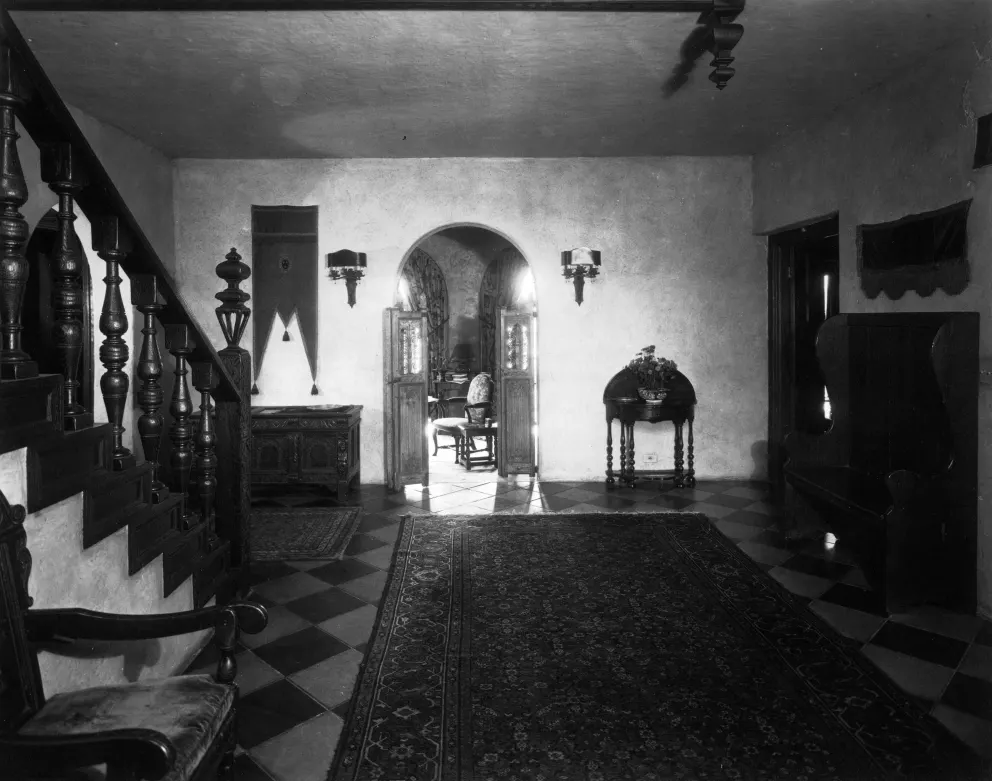
Interior of a vintage room with staircase, furniture, and patterned floor.
The interior of the house, just as the exterior, displays a number of signature Bowman features that are often reminiscent of English homes: arched doorways, stone entry floors, oak paneling, exposed structural timbers, substantial fireplace surrounds of carved wood or stone, leaded-glass windows, and a sunken living room.
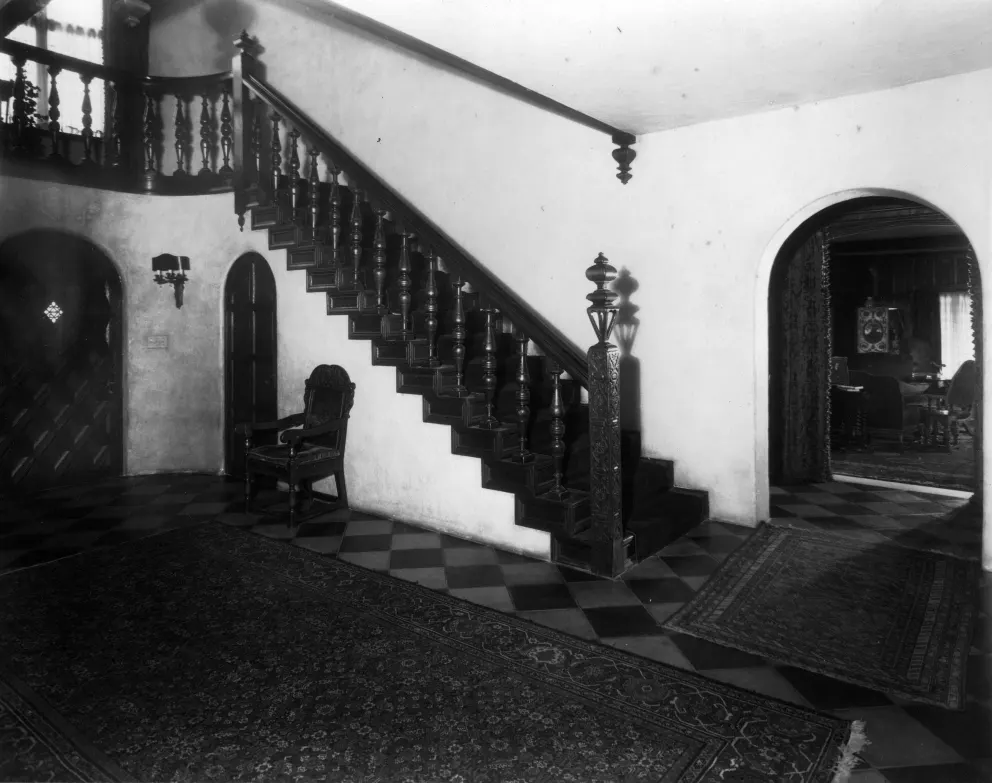
Vintage interior with staircase, chair by the wall and patterned floor.
An arch in the turret leads to the carved and studded front door that opens into the spacious square hall with a stone checkerboard floor. Four rooms are accessed from the grand entry hall, as is the upper floor.
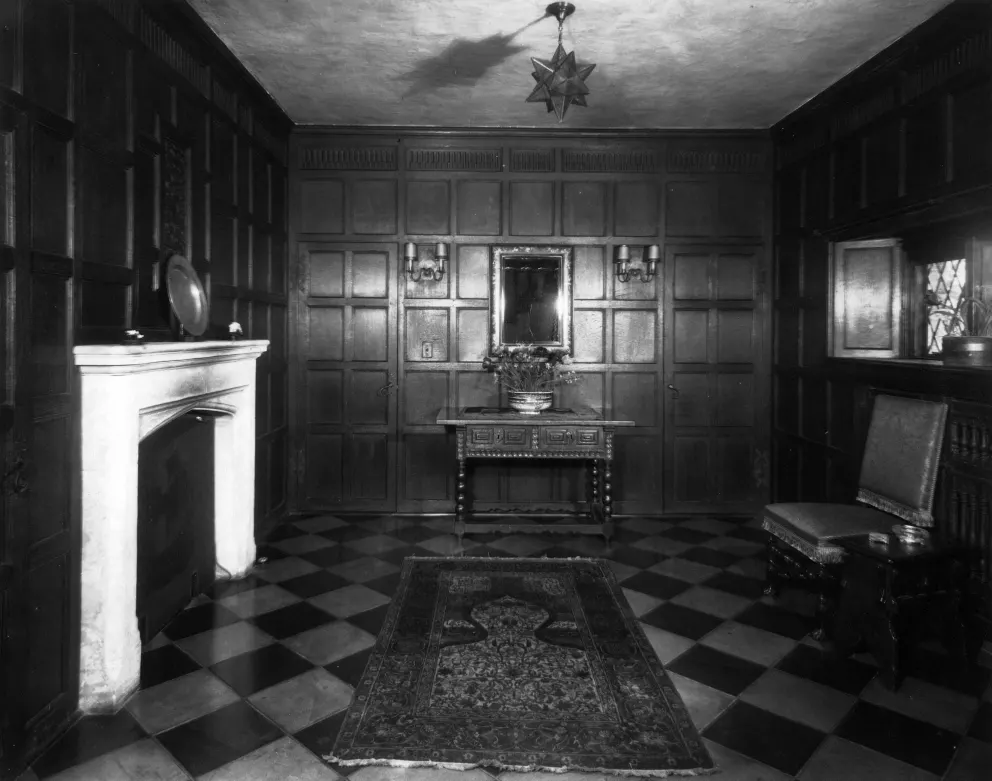
Vintage room with checkered floor, wooden paneling, fireplace, and decorative furniture.
To the right of the entry hall is the receiving room, where a fireplace warms guests and closets receive coats. Former Sarah Lawrence president Alice Ilchman went to great lengths to display, in working order, the grandfather clock made by the venerable Colonial Manufacturing Company of Zeeland, Michigan. The short hall at the rear leads to a powder room and the kitchen.
Vintage room with ornate wood paneling, furniture, and a fireplace.
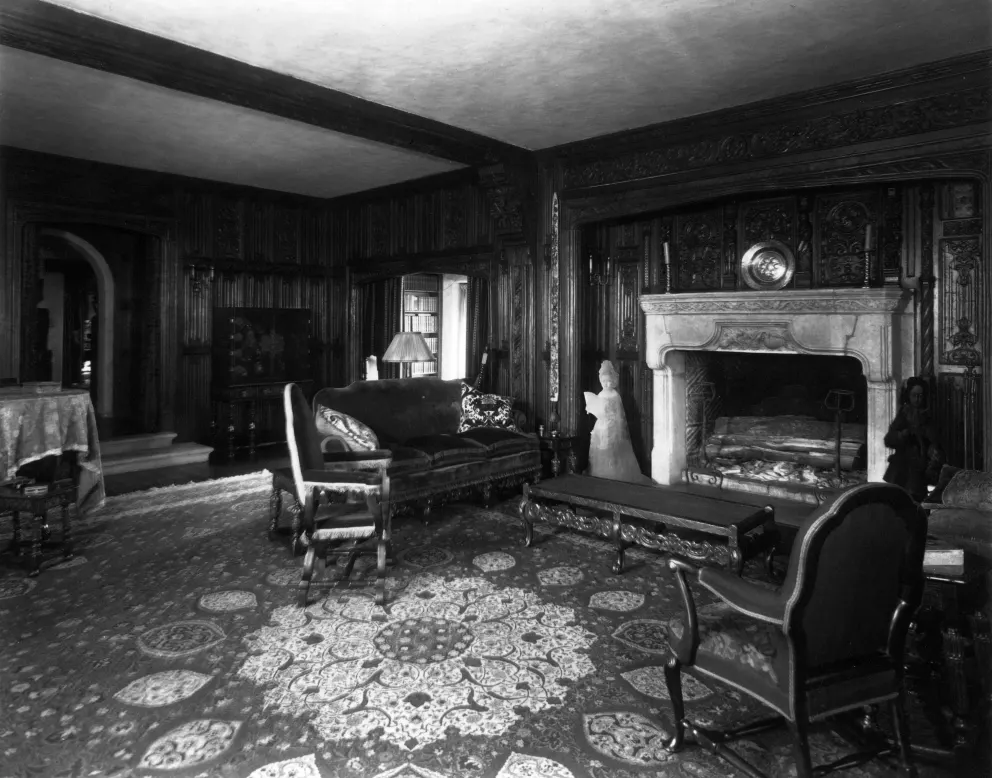
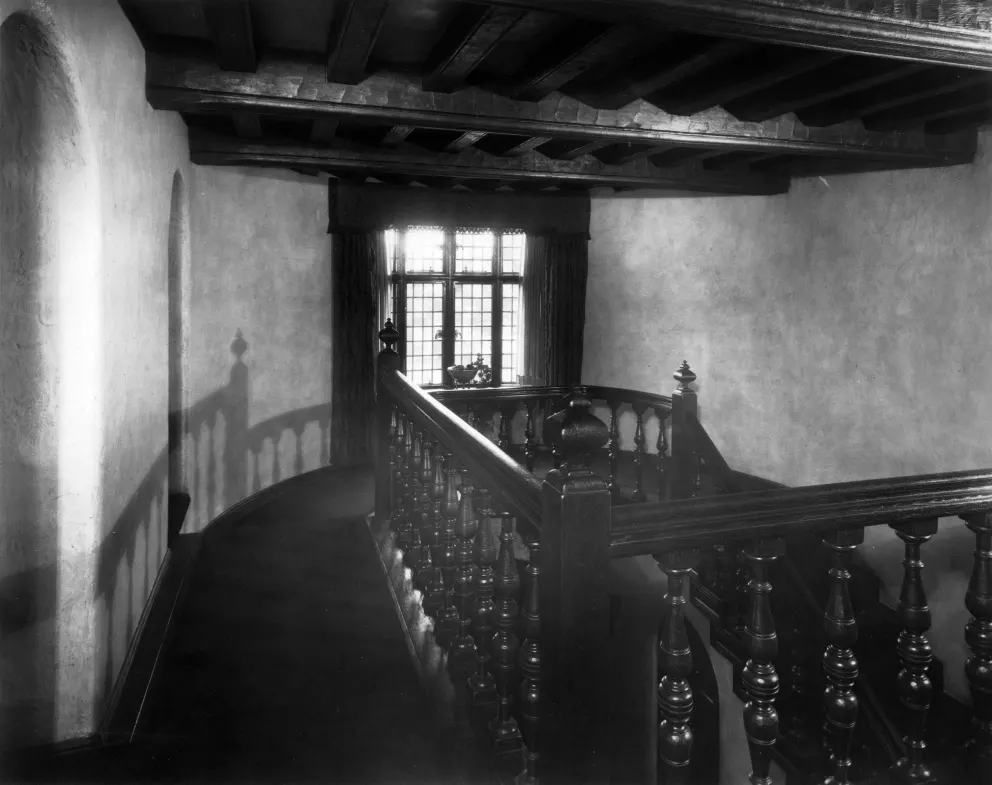
On the opposite side of the entry hall from the receiving and dining rooms is the imposing living room. To the left of the entry to this grand room is the handsome staircase to the upper floor, with an open-heart finial on the newel post, stepped stringers, and a landing that follows the curve of the turret. Beyond the stairs and two steps down is the 35-foot-long living room.
Vintage room with ornate wood paneling, furniture, fireplace, and patterned rug.
The paneling in this room is reputed to have come from a country home in Ipswich, England. The linen-fold paneling is in three tiers from floor to ceiling, and the room is divided into three distinct spaces. The first portion of the room includes a book-lined alcove, perhaps originally intended as a space for a piano.
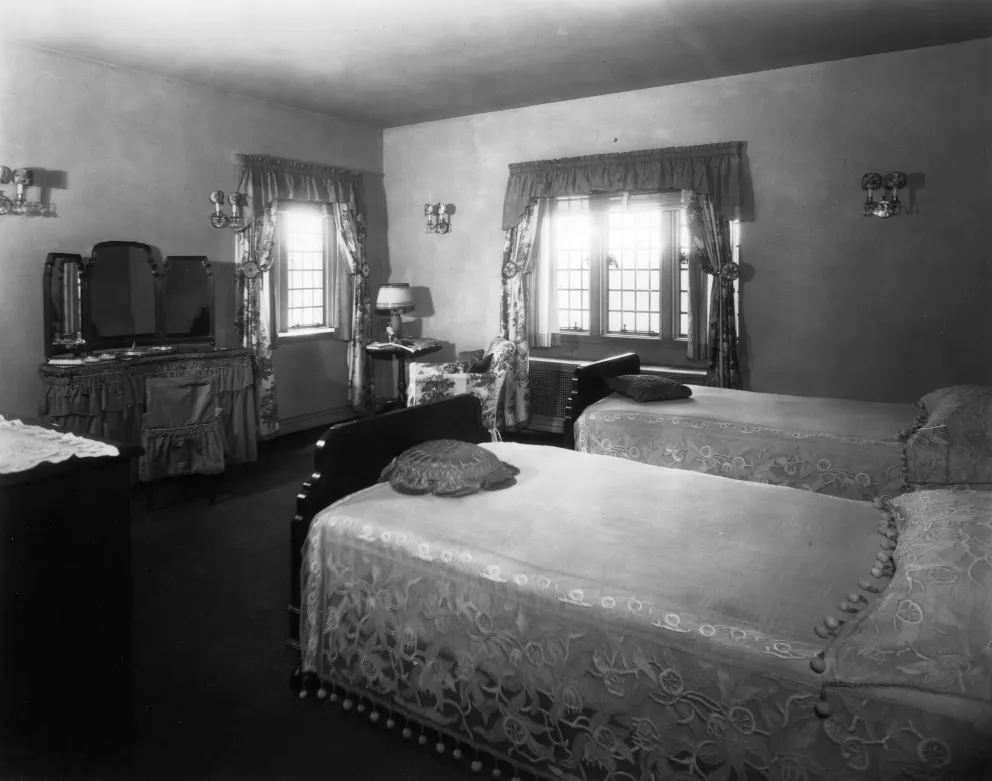
Vintage room with two beds, a dresser, and draped windows.
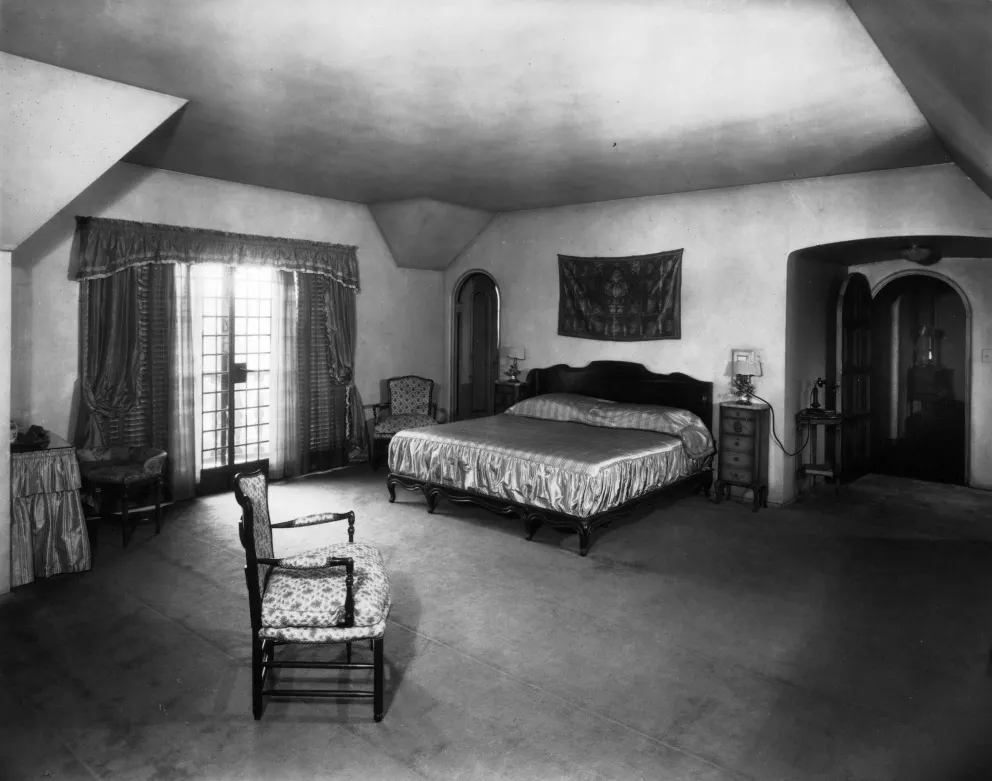
There are three main bedrooms with baths on this floor, and a smaller back bedroom with bath.
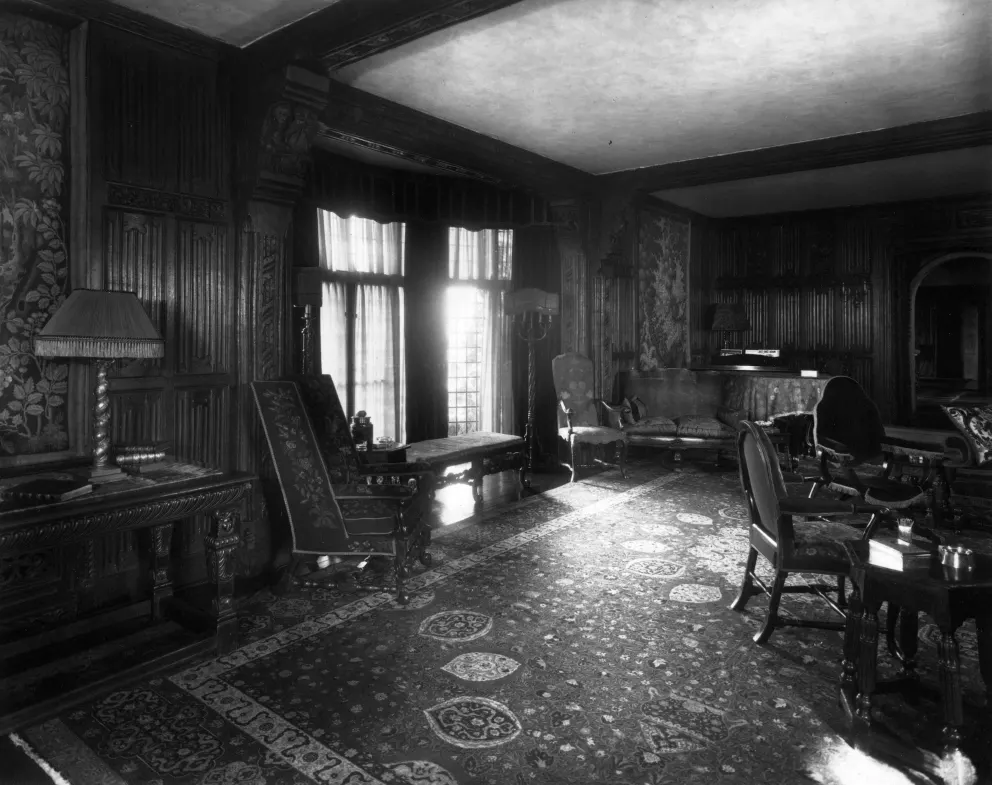
Historic room with ornate wooden panels, furniture, piano, and patterned carpet.
The most dramatic part of the room is the center portion with the deep bay window on the right, and the carved stone fireplace on the left. There is an Aesop fable theme carved into the stone below the mantel, and representations of Adam and Eve carved in wood above. The pilasters that introduce the bay are especially rustic and seem to have been carved directly from undressed tree trunks.
Vintage photo of a stone cottage with a large chimney, surrounded by manicured gardens.
A large door at the far end of the living room leads to a covered terrace that allows an extension of entertaining space in warm weather.
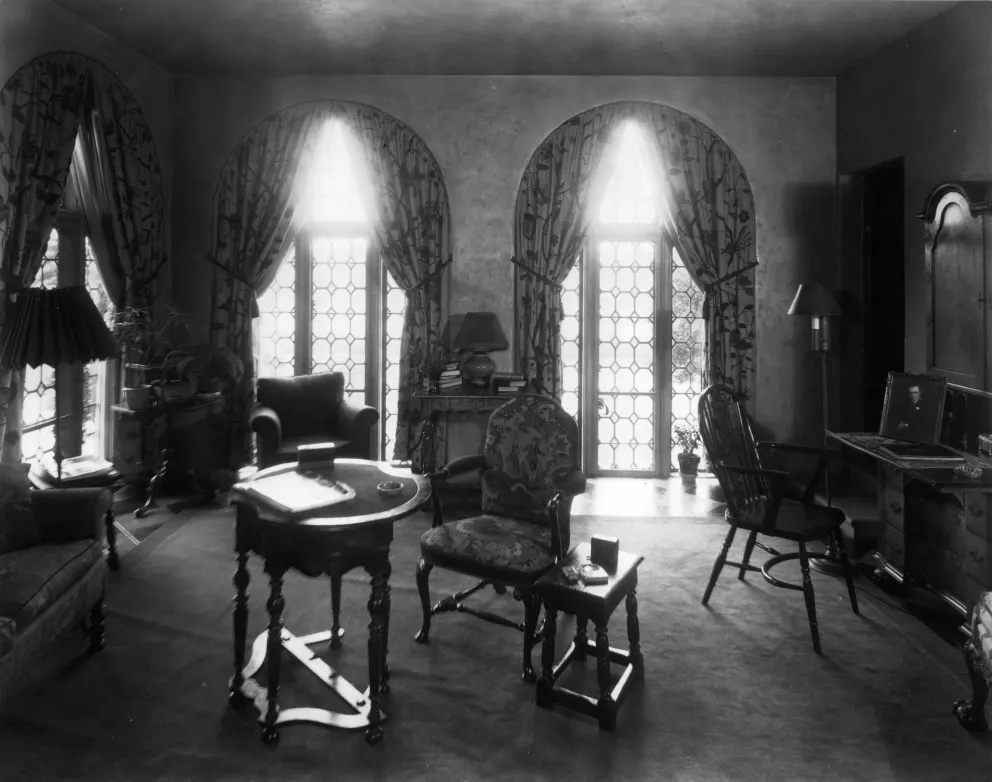
Elegant room with arched windows, curtains, antique furniture, and a writing desk.
Also approached from the entry hall, on the rear side of the house, is the carved linen-fold gate that leads to the library. The gate shows a bespectacled monk, among other carvings. The library was originally intended to be a loggia (an open covered porch), hence the tall, arched pairs of French doors leading to an open terrace and the garden.
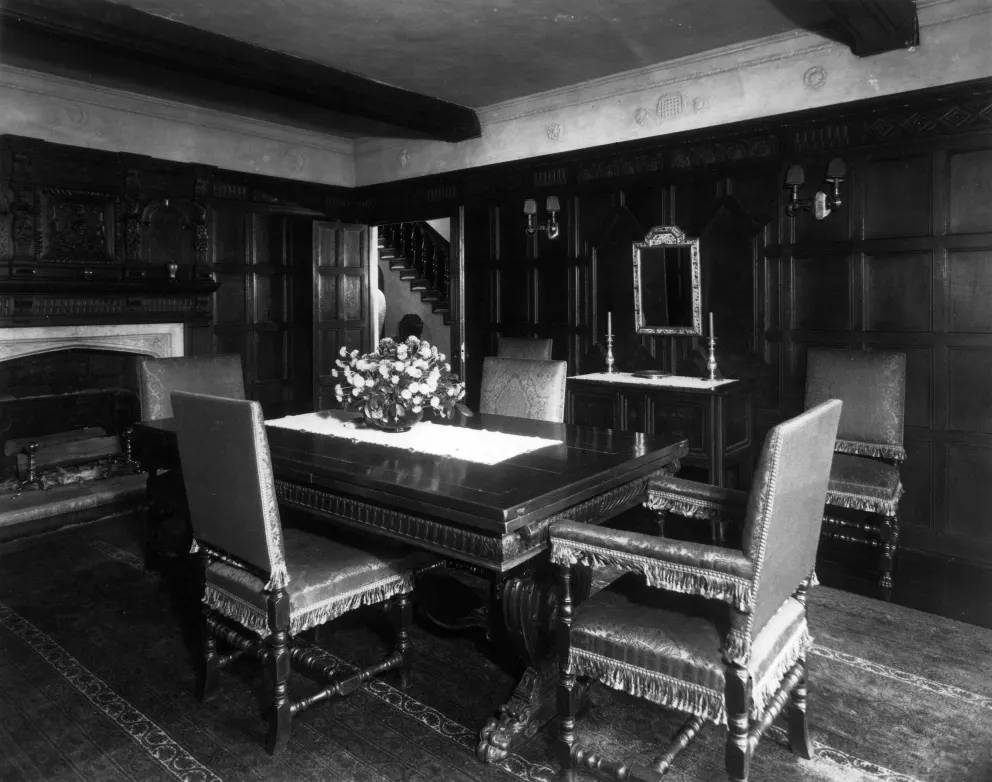
Vintage room with ornate furniture, a fireplace, and a staircase.
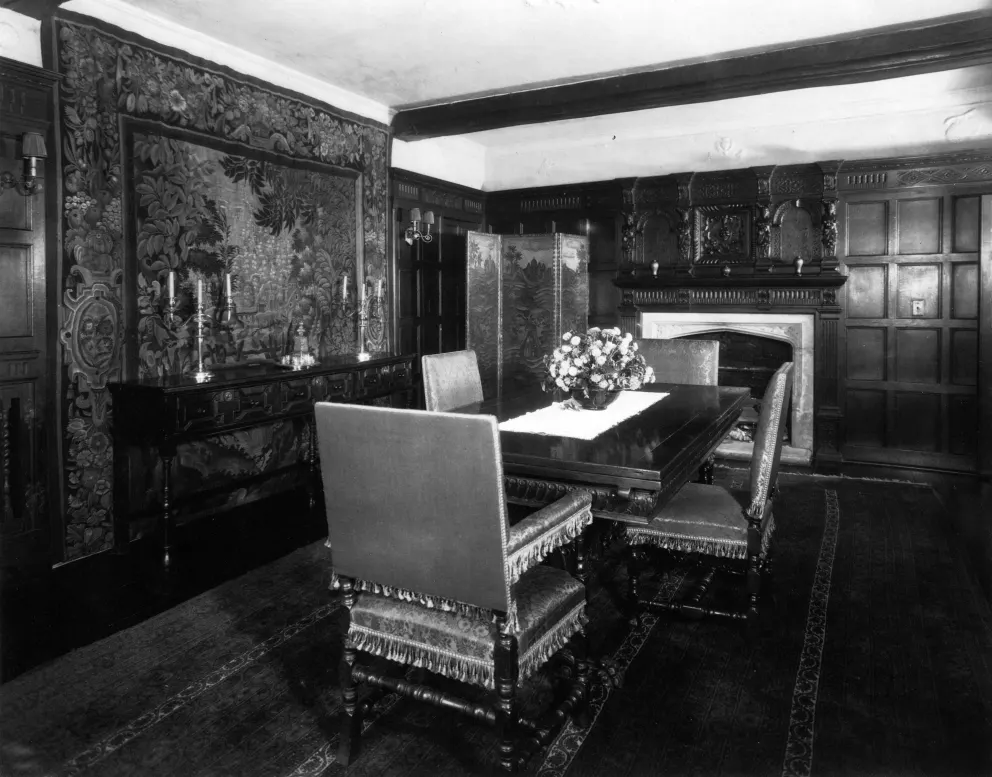
Opposite the living room, the entry hall opens into the dining room. Except for the wall space left plain to accommodate a sideboard, chamfered dark oak paneling surrounds the dining room. In years past, a tapestry left by the Morrills hung over the sideboard. The fire screen with the ship image is also a Morrill donation.
Vintage dining room with ornate furniture, a fireplace, and tapestry.
The plaster ceiling is ornamented with examples of feudal motifs, such as the portcullis, a symbol of strength. The dining room is lit only by the wall sconces. Of note is the subtle way Bowman hid the modern utilitarian radiator covers with finely wrought "torsade" spindles. Two secret panels harbor space for wine bottles.
Vintage photo of an interior with a wooden staircase and balustrade, casting a shadow on the wall.
The upstairs is kept private for the current president and family. The landing is nestled in the curve of the turret, and the floor of the landing provides the roof over the front door below, which protects visitors as they wait to be admitted.
Vintage bedroom with large bed, chair, patterned curtains, and arched doorway.
Upstairs is a sitting room, originally the breakfast room. The east-facing windows not only allow in the morning sun, but also provide a view back to the campus. The warm-hued terra cotta tile on the floor and the cozy fireplace made this a pleasant place to begin the day, and breakfast was always served hot, thanks to the dumbwaiter to the kitchen just outside the door in the back hall.
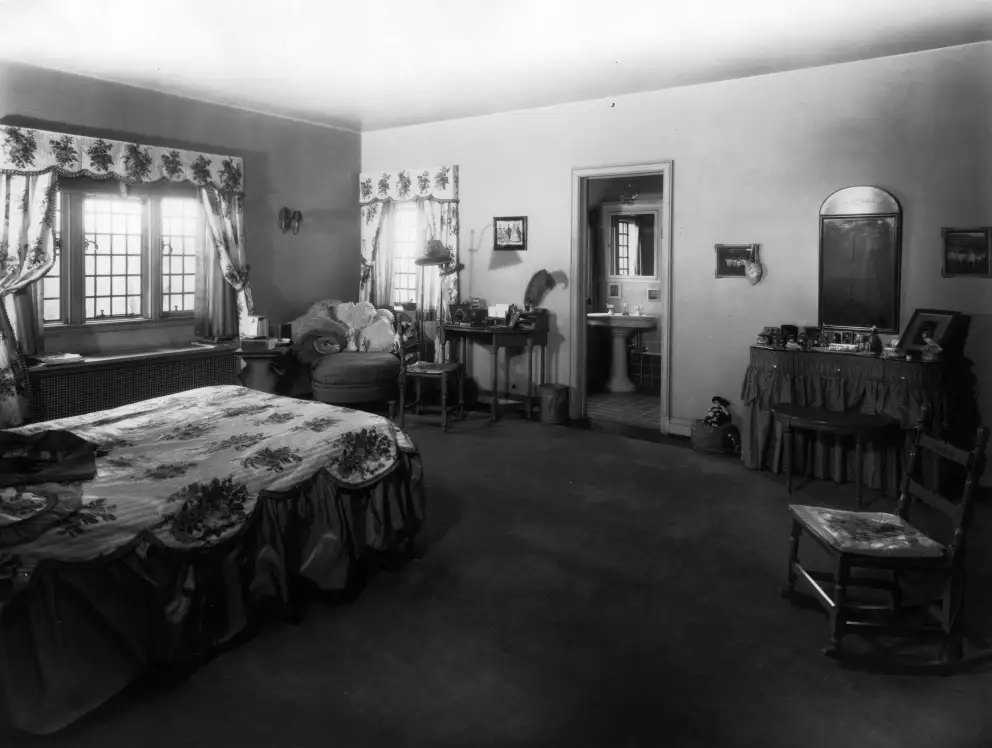
Vintage room with bed, desk, curtains, and decorative items.
There are three main bedrooms with baths on this floor, and a smaller back bedroom with bath.

The President's House at 935 Kimball Avenue is the third building to house Sarah Lawrence College presidents. The first house, originally Wayside Cottage, is now known as Warren Green, located at 7 Mead Way. In 1947, the College acquired 24 Brook Road, but it was slated to be torn down in 1954 to make room for the new Sprain Brook Parkway. Luckily, the lovely Lewis Bowman Tudor just west of the campus was going on the market. The price, though, was $100,000 and the eminent domain payment for the soon-to-be-demolished 24 Brook Road was only $40,000. Nevertheless, the house was so exquisitely suitable, and also included three acres of prime land, that the College trustees agreed it was worth considering. Careful negotiation brought the price to $75,000, and the sellers, Mr. & Mrs. Russell Morrill, offered to donate many of the furnishings as well. To honor the Morrills' generosity, the College named the right wing, "Morrill House."

Commissioned by financier Roy C. Graham, architect Lewis Bowman began the drawings in 1924 and the house was most likely finished by late 1925. The main house originally contained four master bedrooms and five baths with "ample servants quarters." The Grahams were to enjoy the house for only a few years, however. For reasons that are not clear, after the 1929 market crash Bowman agreed to buy back the house. This generous act may have served to save Graham, who went on to become president of the Credit Clearing House, but it was a financial blow to Bowman, from which he never recovered. For a short time, prior to the Morrills' occupancy, the home was owned by Mr. & Mrs. Robert Hayward.

In addition to minor updates over the years, the house underwent major renovations from 1991 to 1994, during Alice Ilchman's presidency.

Host Your Event at the President's House

Now available for rental, the century-old President's House offers striking interior settings and a spacious backyard and terrace for events large and small.
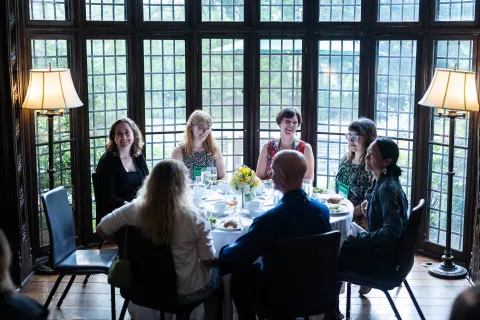
Seven people sitting around a dining table with a white tablecloth and flower centerpiece, in a room with large windows and two floor lamps.

History prepared by Marilynn Hill and Abby Lester, 2017
Adapted from the 2004 Bronxville Historical Conservancy House Tour by Marilynn Hill and Carolyn Martin

© Sarah Lawrence College. All rights reserved.