Faculty
Martin Goldray
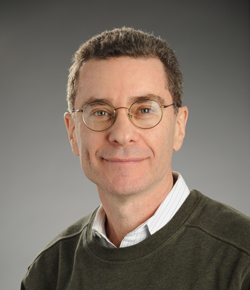
Marjorie Leff Miller Faculty Scholar in Music
BA, Cornell University. MM, University of Illinois. DMA, Yale University. Fulbright scholar in Paris; pianist and conductor, with special interests in 17th- through 20th-century music. Performed extensively and recorded as pianist, soloist, chamber musician, and conductor; performed with most of the major new music ensembles, such as the New Music Consort and Speculum Musicae; worked with composers such as Babbitt, Carter, and numerous younger composers and premiered new works, including many written for him. Toured internationally as a member of the Philip Glass Ensemble from 1983-1996; conducted the premieres of several Glass operas and appears on many recordings of Glass’s music. Conducted film soundtracks and worked as producer in recording studios. Formerly on the faculty of the Composers Conference at Wellesley College. 2010 Recipient of the Lipkin Family Prize for Inspirational Teaching. SLC, 1998–
Undergraduate Courses 2026-2027
Music
-
By Audition, Component—Year
MUSC 5321
Prerequisite: Theory II: Basic Tonal Theory and Composition (MUSC 5110) or permission of the instructor
This course is designed to enable students who have never conducted before to rehearse and perform a piece with a chamber orchestra at the end of the spring semester. The fall semester will begin with score-reading techniques such as reading C-clefs; understanding transposing instruments; mastering beat-patterns; conveying articulation and dynamics; cueing; and will also focus on instrumental techniques and orchestration. Students will hone their interpretive skills by comparing different recordings of pieces, and will apply those skills by leading rehearsals of pieces for piano and small combinations of instruments. A small portion of each class will be devoted to the analysis of conducting styles on video. In the spring semester, students will choose a piece to work on with the Westchester Chamber Soloists for performance.
Faculty
-
Intermediate/Advanced, Component—Year
MUSC 5361
Prerequisite: Theory II: Basic Tonal Theory and Composition (MUSC 5110) or permission of the instructor and Conducting I (MUSC 5321) or prior conducting experience
This component is for students who have completed Conducting I (MUSC 5321) or who have significant prior experience conducting. We will review the skills and techniques learned in Conducting I: reading C-clefs; understanding transposing instruments; mastering beat-patterns; conveying articulation and dynamics and cueing. We will also continue to study instrumental techniques and orchestration and continue to refine interpretive skills by comparing different recordings of pieces. Students will then apply those skills by leading rehearsals of pieces for piano and small combinations of instruments. In the spring semester the students will conduct the Westchester Chamber Soloists in concert.
Faculty
-
Open, Component—Spring
MUSC 5161
This course will study David Bowie’s music styles and cultural influences over a career that spanned almost fifty years. The focus will be on how he conveyed through music and lyrics ideas about alienation, isolation, madness, dystopia, gender ambiguity and identity, glamour, role-playing and self-realization, among other things. We will trace how he conveyed those ideas by using elements of German Expressionism, Weimar cabaret, Asian culture, dadaism, surrealism, European art films (by Buñuel, Dalí, Fellini, Dreyer, Bergman, and others), the cut-up technique made popular by William S. Burroughs, commedia dell'arte, English music hall, the Broadway musical, mime, French chanson, blues, soul, Krautrock, minimalism, science fiction, and other things. We will attempt to understand what was more interesting to him than conventional pop stardom, and why he sought an exit from that whenever he achieved it. Singer and songwriter Siouxsie Sioux said that Bowie was an unusual pop star in that he comes with a reading list; we will try to find out what might be on that list and how it might illuminate his career.
Faculty
-
By Audition, Component—Year
MUSC 5013
Prerequisite: permission of the instructor
Faculty
-
Open, Component—Year
MUSC 5365
This performance ensemble will be an opportunity for students, regardless of the degree of previous experience on an instrument or voice, to explore a wide range of genres and styles and to prepare for a concert at the end of the semester. The goal of this course is to apply the musical terms as they are encountered in Theory I: Materials of Music (MUSC 5105) to an active musical context. Students wishing to explore songwriting on their own will have an opportunity to do so in spring.
Faculty
-
Open, Component—Fall
MUSC 5254
The impact of The Beatles has been immeasurable. In their seven years as an international touring and recording band, they explored and enlarged every aspect of songwriting technique, producing musical milestones with almost every album. This course will trace the development of The Beatles chronologically and will focus on the ways The Beatles used harmony, phrase structure, rhythm, structural ambiguity, sonority, and production techniques in continuously innovative and beautiful ways. The background to this course will be the political events and social transformations of the 1960s, as well as the musical styles and cultural phenomena that The Beatles assimilated and transformed. No previous musical training or experience is required.
Faculty
Music History
-
Open, Lecture—Spring
MUHS 2161
This course will study David Bowie’s music styles and cultural influences over a career that spanned almost fifty years. The focus will be on how he conveyed through music and lyrics ideas about alienation, isolation, madness, dystopia, gender ambiguity and identity, glamour, role-playing and self-realization, among other things. We will trace how he conveyed those ideas by using elements of German Expressionism, Weimar cabaret, Asian culture, dadaism, surrealism, European art films (by Buñuel, Dalí, Fellini, Dreyer, Bergman, and others), the cut-up technique made popular by William S. Burroughs, commedia dell'arte, English music hall, the Broadway musical, mime, French chanson, blues, soul, Krautrock, minimalism, science fiction, and other things. We will attempt to understand what was more interesting to him than conventional pop stardom, and why he sought an exit from that whenever he achieved it. Singer and songwriter Siouxsie Sioux said that Bowie was an unusual pop star in that he comes with a reading list; we will try to find out what might be on that list and how it might illuminate his career.
Faculty
-
Open, Large seminar—Fall
MUHS 3164
The impact of The Beatles has been immeasurable. In their seven years as an international touring and recording band, they explored and enlarged every aspect of song-writing technique, producing musical milestones with almost every album. This course will trace the development of The Beatles chronologically and will focus on the ways the Beatles used harmony, phrase structure, rhythm, structural ambiguity, sonority and production techniques in continuously innovative and beautiful ways. The background to this course will be the political events and social transformations of the 1960s, as well as the musical styles and cultural phenomena that The Beatles assimilated and transformed. No previous musical training or experience is required.
Faculty
Previous Courses
Music
-
By Audition, Component—Year
MUSC 5373
Prerequisite: permission of the instructor
Faculty
-
First-Year Studies—Year
MUSC 1026
This FYS seminar will examine the various genres of music that have pervaded cultural life in the West, focusing on classical music, folk, rock, and punk. The first semester will begin with the foundations of classical aesthetics in ancient Greece and continue with the study of landmarks of classical music through the Medieval, Renaissance, Baroque, and Classical periods. The spring semester will begin with 19th-century romanticism and continue with the development of 20th-century modernism, the rise of mass media and technology, the splitting of culture into high and low, the rock & roll revolution, and the more recent attempts at bridging the gap between high culture and popular cultures. The students in this seminar will have weekly conferences through October Study Days and then biweekly conferences for the rest of the school year.
Faculty
-
Open, Seminar—Spring
This course will provide an opportunity for students to refine and deepen their listening skills with music that the students select themselves and bring to the class. The material for the course will be generated entirely by the students. We will spend a little time at the beginning of the semester developing a terminology for describing and analyzing music, focusing on harmonic and rhythmic techniques, structure, how voices and instruments are used, recording techniques, and how lyrics and music can be related. Each of the weekly meetings of the class will be devoted to student presentations and class discussions. Students will present every three or four weeks. The goals of the class are to listen more actively and critically, to find ways to express verbally what we’re hearing, to sharpen our understanding of our likes and dislikes, and to share our musical interests with others.
Faculty
-
Open, Seminar—Spring
This course will provide an opportunity for students to refine and deepen their listening skills, using music that the students select themselves and bring to the class. The material for the course will be generated entirely by the students. The class will meet once a week. The first part of each meeting will be devoted to developing a terminology for describing and analyzing music, focusing on things such as harmonic and rhythmic techniques, structure, how voices and instruments are used, and how lyrics and music can be related. The second part, and the majority of each class session, will be devoted to student presentations and class discussions using the analytical skills that we have developed. So the starting point of each discussion will be music that the student already knows well. Students will present every two or three weeks. The goals of the class are to listen more actively and critically, to find ways to express in words what we’re hearing, to sharpen our understanding of our likes and dislikes, and to share our musical interests with others.
Faculty
-
-
-
Open, Large Lecture—Fall
Music is central to most of our lives. How can we understand the experience of music? What does music express? If it expresses emotions, how do those emotions relate to the emotions that we experience in everyday life? Can music without words express emotions with as much clarity as music with words? As a background to these questions, we will look at issues concerning the nature and experience of art in general. We will examine the views of writers such as Plato, Kant, Schopenhauer, Dewey, and Adorno and compare how they understand the role of art in society, along with our own experiences. The musical repertory will include medieval and Renaissance music, music by Bach, songs by Schubert, and examples from the symphonic repertory of composers such as Haydn, Mozart, Beethoven, Schubert, Tchaikovsky, and Stravinsky. We will study those works using the techniques of formal analysis that are generally used in music-history classes but also attempt to draw out the many contextual threads: How are they embedded in a culture, and how do they reflect the temperament and orientation of the composers? While most of our musical examples will be from the classical repertory, other styles will occasionally be relevant. The goals of the class are to understand how musical and philosophical thought can illuminate each other and to deepen our awareness of the range and power of music. No prior knowledge of music theory or history is required; we will introduce and define the terms that we need as the class proceeds.
Faculty
Music History
-
Open, Lecture—Spring
MUHS 2014
This course will examine punk rock as a musical style and as a vehicle for cultural opposition. We will investigate the musical, cultural, and political conditions that gave birth to the genre in the 1970s and trace its continuing evolution through the early 2000s—in dialogue with and opposition to other musical genres, such as progressive rock, heavy metal, ska, and reggae. We will begin with the influence of minimalism on “proto-punk” artists like the Velvet Underground and Patti Smith, which will provide a foundation for seeing how minimalism—as well as modernism, atonality, and electronic music—continue to resonate in punk and rock music. We will examine the intellectual background of early UK punk, with readings by Guy Debord and the Situationist International, and look at the theories of Gramsci and Foucault on the question of institutional power structures and the possibility of resistance to them. To deepen our understanding of punk style and the culture of opposition, there will also be readings by Theodor Adorno, Mikhail Bakhtin, Roland Barthes, Antonin Artaud, William S. Burroughs, Kathy Acker, Julia Kristeva, and others. We will trace the splintering of punk into various subgenres and the challenges of negotiating the music industry while remaining “authentic” in a commercialized culture. Another major focus will be on the Riot Grrrl bands of the 1990s as a catalyst for third-wave feminism. Given the DIY aesthetic at the heart of punk and in addition to listening to, analyzing, and reading about the music, students who want to incorporate creative work will be given the opportunity to work with musicians and write some punk songs. In light of the abundant documentary film footage relating to punk culture, the course will include a film viewing every other week.
Faculty