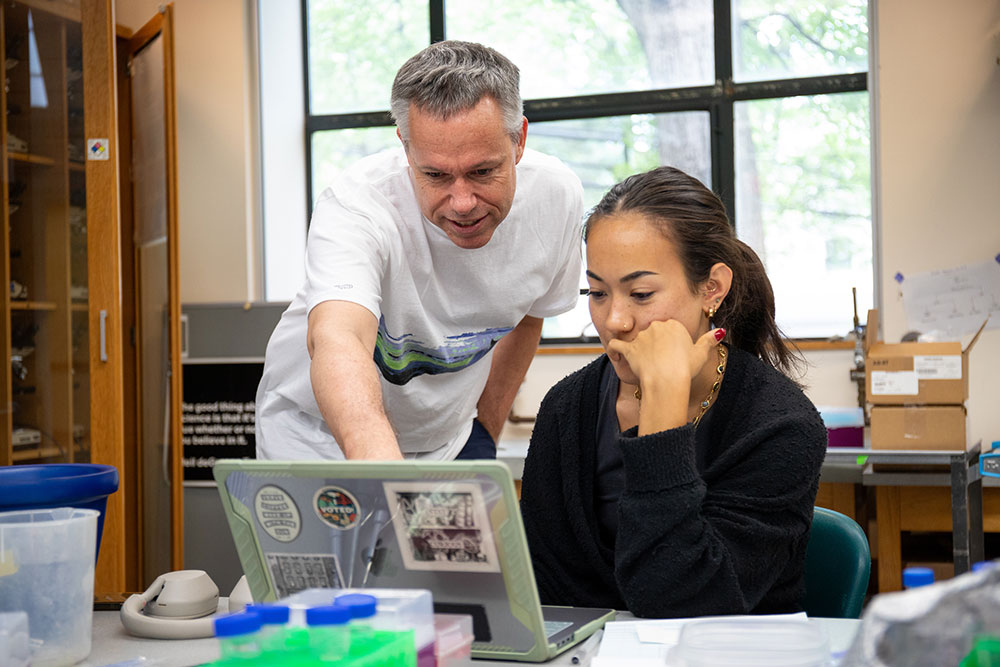
Sarah Lawrence faculty member Drew Cressman’s research focuses on investigating a protein called the “master regulator” of the immune system. Last summer, he collaborated with four students who each owned a distinct part of the puzzle. Their research into how this protein behaves could have significant implications for the future of precision medicine, helping the body respond more effectively to infections, cancers, and autoimmune diseases.
For the past two decades, students and faculty at SLC have tackled similar problems through the Summer Science program. What began with just a single student and Drew, a molecular biologist, has grown to provide approximately 15 to 20 students with research opportunities across the fields of math and science every summer. Participating students and faculty receive stipends for their work, thanks in part to a generous endowment from Vicki Ford ’60, MSEd ’87 and the late Suzanne Salter Arkin ’60.
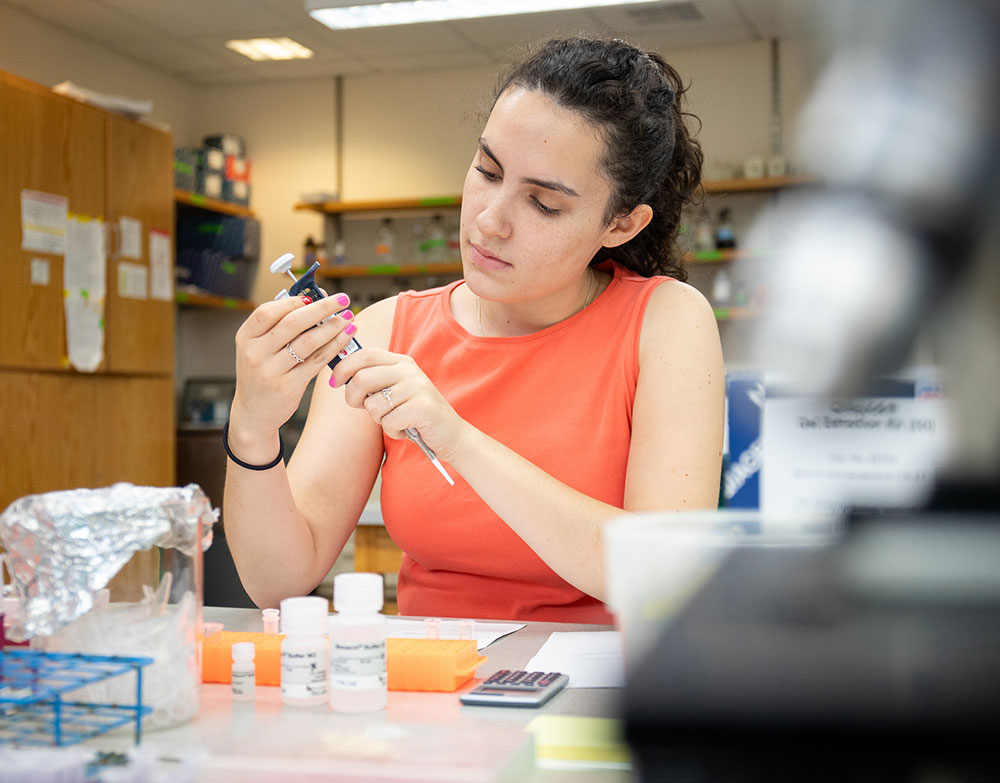 Isabel Lavery, a junior interested in epidemiology, investigated how that “master regulator” protein (technical shorthand: CIITA, for Class II Major Histocompatibility Complex Transactivator) affects levels of another protein in the body called KPNA6. In short, CIITA tells the immune system what to attack; KPNA6 helps CIITA get to the place where it can do that job.
"I love that we're doing things that are physically there, and you can see a result," Isabel says. "Nobody's done this before, and here it is, right in front of me."
Senior Perry Yun focused on what regulates CIITA's half-life, or how long the protein remains stable before degrading. "There's not a lot of research on this," Perry explains. "So anything I find out could potentially be a publication."
At the heart of the program is Sarah Lawrence’s singular approach to education: undergraduates work like graduate students, allowing them to develop their sense of how scientists think and work.
"At Sarah Lawrence, you're working hand-in-hand with the faculty member, getting direct research experience," says physics faculty and program director Merideth Frey.
Drew’s natural ease with students in the lab contributes to the team’s success.
"It surprised me how excited he is to answer any question," Perry says. "I feel like he has a lot of confidence in me, and it makes me want to push myself that much harder.”
Summer Science lasts eight weeks and culminates in presentations where students share their findings with the college community. They often present their research at national conferences, too.
Isabel and Perry’s work is a testament to the long-term impact of the Summer Science program; students gain practical research experience, but, more importantly, they gain confidence as scientists, contributing discoveries that could potentially advance medical science. It all comes back to Sarah Lawrence’s unique recipe for igniting curiosity — giving students the freedom to direct their own learning alongside expert faculty who are wholly dedicated to their success.
Students interested in Summer Science opportunities can contact program director Merideth Frey at mfrey@sarahlawrence.edu.