About the Program Director
Meet Caden Manson, Director of the Theatre Program, BA and MFA
“I want students to leave Sarah Lawrence knowing how to make the work they need to make, how to build the structures that allow that work to exist, and how to find the people they want to make it with. I think of an artistic life as something larger than a career. It is a way of paying attention, asking questions, building community, and participating in the world.”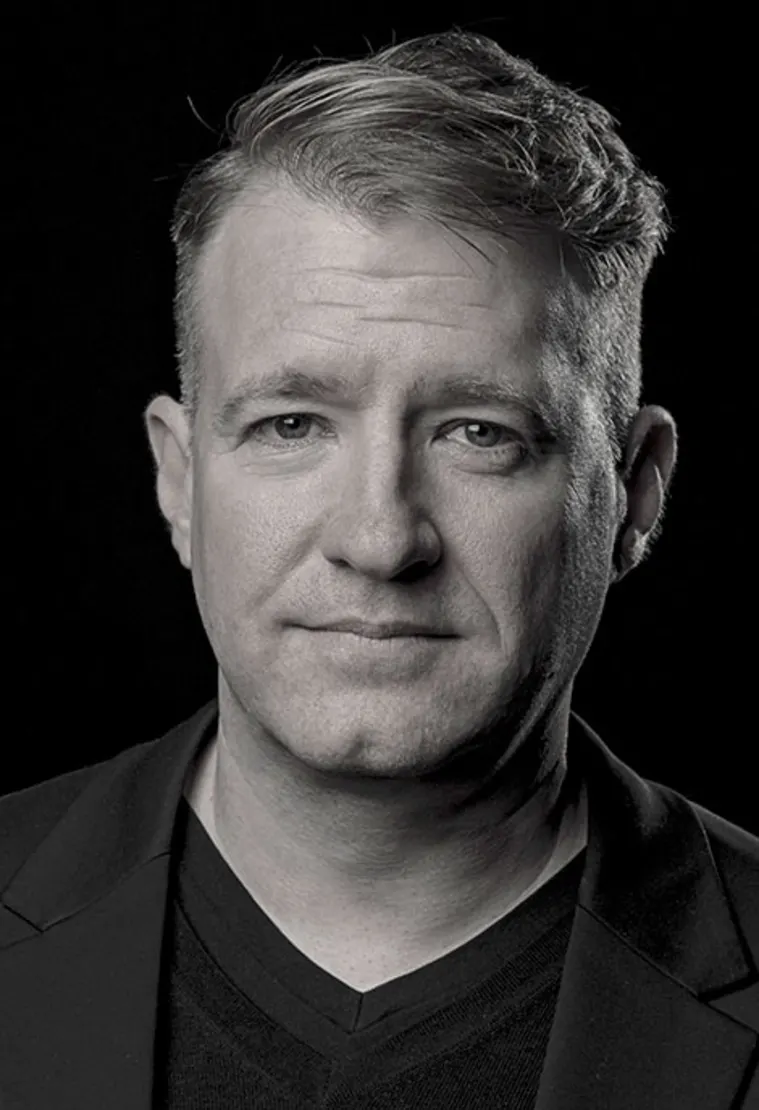
Background
Education
Caden Manson earned a BA in Theatre from the University of Texas at Austin and an MFA in Creative Practice from the Transart Institute for Creative Research at Liverpool John Moores University.
Experience
Caden Manson is an artist, curator, and educator whose work investigates the relationship between bodies, media, technology, and spectatorship. They co-founded Big Art Group, an experimental performance and media ensemble they started with Jemma Nelson in New York City in 1999, and serve as its Artistic Director.
With Big Art Group, Manson has created performances that move between theatre, film, installation, choreography, and visual art. Their work has been presented in more than 50 cities across 14 countries, including La Biennale di Venezia Teatro, the Vienna Festival, Festival d’Automne à Paris, Hebbel am Ufer, Festival de Otoño, and The Kitchen in New York City. Major works include Flicker, House of No More, The People, and Broke House.
Manson developed Real Time Film, a performance technique that combines live bodies, cameras, choreography, constructed images, and simultaneous live video to confront complex issues about contemporary experience. Their artistic practice frequently uses interference, slippage, fragmentation, and excess to examine identity, embodiment, power, and the construction of reality.
They are also the founder of Contemporary Performance, an international platform connecting interdisciplinary artists with writing, resources, professional development, and opportunities, and co-curator of the annual Special Effects Festival in New York City.
Manson is a Foundation for Contemporary Arts Fellow, Pew Fellow, and MacDowell Fellow. Their writing with Jemma Nelson has appeared in PAJ, Theater, Theater der Zeit, and Theater Journal. Before coming to Sarah Lawrence, Manson taught at Carnegie Mellon University, where they headed the John Wells MFA Directing Program. They joined Sarah Lawrence in 2019 and direct the undergraduate and MFA Theatre Programs.
Interests
Education/Research: Interdisciplinary performance, artistic research, contemporary performance, embodied practice, collaboration, media and performance, queer performance, experimental dramaturgy, new forms of spectatorship, artistic process, creative practice, and the structures artists build to sustain creative lives.
Caden is particularly interested in how artists develop a practice rather than simply produce individual works. That means thinking about research, experimentation, collaboration, writing, documentation, community, and professional life as interconnected parts of being an artist.
Creative: Caden’s work begins with the body and its collision with images, technology, narrative, and systems of representation. They are interested in moments when these systems stop lining up cleanly, when a live body contradicts its image, when narrative fragments, or when an audience has to negotiate several realities at once.
Caden uses performance to create spaces where embodiment, media, and code interfere with one another. They are interested in queer dramaturgies, excess, spectacle, disruption, and the unstable relationship between what we see and what we believe.
Personal: Caden loves contemporary art and performance, reading, hiking, gardening, pottery, strange objects, getting lost in cities, good coffee, and engaging with local, national, and international festivals.
Caden Answers Your Questions
What makes the Sarah Lawrence MFA Theatre Program different?We begin with the artist rather than a predetermined professional category. You do not have to arrive saying, “I am only a director,” “I am only a performer,” or “I am only a designer.” You might be all of those things, or you might discover a practice that does not have a clear name yet. The curriculum is deliberately interdisciplinary, with students working across performance, directing, design, writing, technology, movement, producing, music, dance, and other forms.
After more than twenty-five years making and presenting work nationally and internationally, I have seen that many of the most consequential artists rarely remain inside a single discipline. They move between performance, directing, design, writing, technology, producing, curating, and organizing. The MFA is built around that reality. Our job is to help you deepen what you already know while creating serious opportunities to encounter what you do not know yet.
What are you looking for in an MFA student?Curiosity!
I am less interested in whether somebody arrives already polished than in whether they are genuinely interested in discovering something. I want to know what questions are driving you, what you are paying attention to, and what you are willing to risk in order to develop your practice. The program is foundationally collaborative, so generosity matters too. You are entering a cohort and becoming part of a larger undergraduate and graduate theatre community. Your education happens through your own work, but it also happens through what you contribute to other people’s work.
The strongest students are willing to make things, question them, revise their assumptions, encounter unfamiliar practices, and stay engaged when an experiment doesn't immediately produce an answer.
What do you hope students leave the program knowing?I want students to understand their own practice well enough to articulate what they care about without closing down what that practice might become. That includes artistic skills, but it also means knowing how to research, collaborate, organize a process, communicate an idea, advocate for your work, find resources, build relationships, write about what you are doing, and participate meaningfully in the larger field.
Most importantly, I want students to leave knowing that they have agency. Artists don't have to wait for someone else to give them permission to make a life in the field. You can create work, form communities, build platforms, organize festivals, write, teach, curate, produce, collaborate, and invent structures that do not exist yet.
How does being a practicing artist affect the way you lead the program?I do not think of artistic practice and education as separate activities. Running an arts organization, directing a performance, curating artists, editing a publication, teaching a class, and building a theatre program all involve asking similar questions: What conditions allow people to do meaningful work? How do we bring different people and practices into relationship? Where does experimentation need structure, and where does structure need to get out of the way?
At Sarah Lawrence, I want us to build an environment where rigorous artistic experimentation and care for one another can coexist. We can challenge each other expansively while also creating a community in which people have room to take risks. That is one of the program's central ideas for me. We are not simply training people to enter the theatre that already exists. We are helping artists imagine, create, and sustain the theatre and performance field they want to be part of.
How has your national and international work shaped the MFA?For more than twenty-five years, I have made, presented, and organized work nationally and internationally. Working across different cities, countries, festivals, institutions, and artistic communities has fundamentally shaped how I think about what an MFA should do.
One thing I have learned is that the most interesting artistic lives rarely follow a single path. Artists move between making, performing, directing, designing, writing, teaching, producing, curating, and organizing. They form companies and collectives, create festivals and platforms, build relationships with presenters, and invent new structures when the ones they need do not exist. I want the MFA to reflect the reality of that field.
Working internationally has also exposed me to very different ideas about what theatre and performance can be, how artists can work together, and how institutions can support artistic practice. There is no single model. That has made me deeply committed to an interdisciplinary program where students can encounter different methodologies, challenge their assumptions, and develop a practice that is genuinely their own.
My national work as an artist, curator, publisher, and organizer has been equally important. Through Big Art Group, Contemporary Performance, Special Effects Festival, and relationships with artists and organizations across the field, I have spent much of my career thinking about how artists find one another, how work circulates, and how artistic communities sustain themselves.
I bring those experiences and relationships back to Sarah Lawrence. I want students to understand that their MFA is connected to a much larger artistic ecosystem. The goal is not simply to prepare them to enter the field as it currently exists. It is to give them the artistic rigor, curiosity, relationships, and agency to help shape what the field becomes next.
Watch, Listen, Read
Website: CadenManson.com
Big Art Group: BigArtGroup.com
Contemporary Performance: ContemporaryPerformance.com
Publications:
- Manson, Caden, and Jemma Nelson. “After Spectacularity.” Theater, vol. 42, no. 3, 2012, pp. 4–9., doi:10.1215/01610775-1597584.
- Nelson, Jemma, and Caden Manson; SOS. Theater 1 May 2010; 40 (2): 41–65. doi: https://doi.org/10.1215/01610775-2009-030
- Manson, Caden, and Jemma Nelson. “Being Contemporary.” PAJ: A Journal of Performance and Art, vol. 34, no. 1, 2012, pp. 43–59., doi:10.1162/pajj_a_00073.
Selected Works: Flicker, House of No More, The People, SOS
Citations:
- Boitel, Stéphane, and Emeline Jouve. “Theatre/Video and the Crossing of Boundaries: Big Art Group’s Flicker (2002–2005): Stitching the Eye/I.” Liminalities: A Journal of Performance Studies 11, no. 2 (June 2015). http://liminalities.net/11-2/stitching.pdf.
- Felton-Dansky, Miriam, and Jacob Gallagher-Ross. “Interface Theatre: Watching Ourselves Disappear.” Modern Drama, vol. 67, no. 1, 1 Mar. 2024, pp. 9–17, doi:10.3138/md-67-1-1288.
- Soloski, Alexis. “All the World’s a Screen? They’Re Used to It.” New York Times, 3 Feb. 2021, pp. 8.New York Times
- Porcedda, Walter. “Biennale, Un ‘Loco’ Tra I Tabù Della Contemporaneità.” Gli Stati Generali, 4 July 2022, https://www.glistatigenerali.com/teatro/biennale-un-loco-tra-i-tabu-della-contemporaneita/. (Italian National Website)
- LAUDENBACH, PETER. “Am Längeren Hebbel.” Der Tagesspiegel, 2 Nov. 2003, www.tagesspiegel.de/kultur/am-laengeren-hebbel/461616.html.(German National Newspaper)
- Gallagher-Ross, Jacob. “Image Eaters: Big Art Group Brings The Noise.” TDR The Drama Review 54.4 (2010): 54-80. Print.(Journal)
- Gallagher-Ross, J. “Babes In The Woods: Big Art Group’s SOS.” Theater, vol. 40, no. 2, 2010, pp. 33–40., doi:10.1215/01610775-2009-029.(Journal)
- Carlson, M. “Mixed Media and Mixed Messages: Big Art Group’s Exploration of the Sign.” Journal of Dramatic Theory and Criticism, vol. 22 no. 2, 2008, pp. 119-131. Project MUSE, doi:10.1353/dtc. 2008.0005(Journal)