About the Assistant Director and Faculty
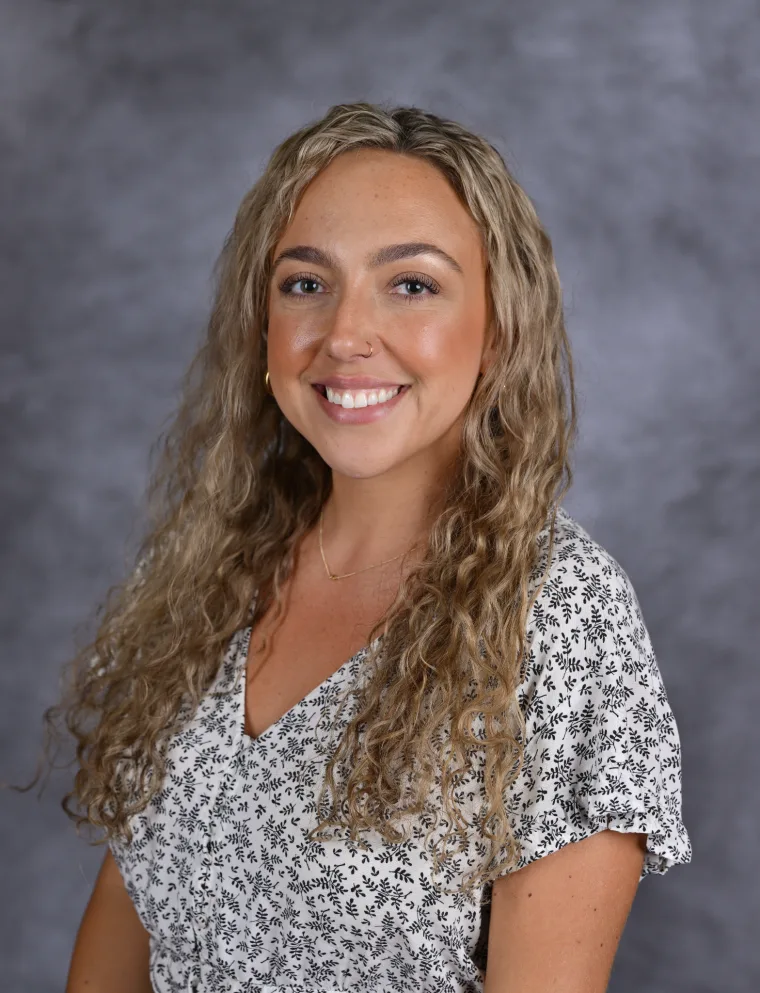
Meet Michelle Bina, Assistant Program Director and Faculty, Joan H. Marks Graduate Program in Human Genetics
"My approach to mentorship comes directly from the type of humanistic support I received while earning my degree."
Background
Education
Michelle earned her BS at the University of California, Los Angeles and her MS in Human Genetics at Sarah Lawrence College. In 2024 she completed the Genetic Counseling Education Fellowship at Sarah Lawrence College.
Experience
After earning her masters degree, Michelle worked as a clinical prenatal and cancer genetic counselor at Montefiore Medical Center in the Bronx. While in this role she provided clinical training and education to Sarah Lawrence genetic counseling students, medical students, residents, and medical fellows.
After becoming a course instructor for the Human Genetics Program in 2020, Michelle joined the program faculty in 2021 to pioneer the Genetic Counseling Education Fellowship. While building on her skills as a program leader, her role focused on experiential learning through fieldwork coordination.
As an assistant program director, Michelle manages students’ fieldwork training, providing support and training to students and supervisors to promote meaningful training experiences. Additionally, she provides academic mentorship to students, advises student thesis projects, and serves on the program’s admissions committee. She currently serves as an instructor for the Disability Studies and Advance Human Genetics courses.
Michelle holds a passion for providing access and advocacy of genetics services to historically underserved communities, and has served on the Outreach Committee for the New York State Genetics Task Force since 2019. She aims to ensure graduates of the Human Genetics Program have training experience with, and appreciation for, diverse communities in the NYC metropolitan area.
Interests
Professional Interests
Reproductive genetics, oncology, LGBTQIA+ healthcare, outreach to underserved communities, improving DEIB in the genetic counseling profession, experiential training, disability advocacy.
Personal Interests
Travel, cooking, reading, exploring the NYC food scene, and spending time with her cat, Ginger.
Michelle Answers Your Questions
We understand that you are an alumni of the program, tell us why you chose to come to Sarah Lawrence and what it was like being a student here.
The long history of the program and large alumni network drew me to apply to Sarah Lawrence, but the innovation and desire to provide students unique training experiences is what pushed me to attend. I was inspired by the passion for education I saw from the program’s leadership and knew I wanted to explore these roles within genetic counseling education. Once here, the program fully embraced this interest of mine and formed an Education Leadership rotation. I now get to host students for this rotation, years later!
As a student, I appreciated how our interests were encouraged as well as how the program sought our insight and feedback as it continuously pushed to evolve. Although we were a large group, it really felt like each students’ perspectives were valued. We loved spending time with the faculty and instructors, from having philosophical discussions and debates to planning social events (cake wars, murder mystery dinners, movie nights, yoga classes, etc!)
I also enjoyed exploring a completely new city! Coming from California, I was excited to finally experience four seasons and become an accomplished public transit commuter. These new frontiers weren’t without their challenges, but were rewarding to look back on how much I grew in two years.
How has your experience being a student in the program influenced your work and teaching in the program?
My experiences in the program actually directly impacted my desire to stay in New York. I knew I wanted to work with, and eventually for, Sarah Lawrence because of how much I believed in the values and ethos of the human genetics program and its faculty, so I wanted to stay nearby. This program, and my experiences in grad school, felt special.
Now in this role, it has given me great joy to be able to seek out unique training experiences for students to embrace their own interests, in the same way mine were embraced. My approach to mentorship comes directly from the type of humanistic support I received while earning my degree. Working on a diverse team draws on many of the values and skills I developed as a student in a large cohort. I aim to promote this type of collaboration and appreciation for differing perspectives among our students during my courses through team-based learning and group discussions.
Tell us about your current role in the Human Genetics program?
Taking on this role as assistant director has been a dream of mine since I was a graduate student myself. As the assistant director who manages fieldwork, I coordinate student practicum experiences, build and maintain partnerships with clinical and community sites, and ensure students gain diverse, hands-on exposure to the practice of genetic counseling. Through training and mentorship I provide support to both students and supervisors to ensure quality fieldwork experiences. I am passionate about promoting compassion, humility, and a sense of belonging in both our students’ experiences and the profession as a whole.
What kinds of fieldwork experience do students in the Human Genetics Program have access to?
Pretty much anything you can think of! If we don’t have it, I always encourage students to join me in searching for new training opportunities or novel roles to explore. From industry roles, advocacy organizations, podcasting experiences, exploration of education leadership, variant curation, post-mortem counseling, and many more opportunities, our students are able to explore some of the newer roles genetic counselors can hold. One domain I’m excited to be currently working on getting a training opportunity in is public policy.
Our students benefit from a diverse portfolio of clinical sites as well: we work with many local and regional sites and networks that allow for students to train in a collection of diverse settings. From working with sole GCs in an institution to large teams of counselors, students receive multiple forms of supervision while serving clients from many different walks of life. While we have a handful of fully-remote clinical sites, many of our sites across the boroughs (and over the bridge in New Jersey!) host our students in-person.
Another unique aspect of our program is the access to simulation-based training. Students start working with simulated patients (actors trained to be a clinical client) and certified genetic counselors in their first semester to work on their genetic counseling skills. Throughout the program this provides the unique opportunity to receive direct feedback from a “patient” and trial new strategies and skills. This has been a great way for students to build their confidence going into their first fieldwork placement in the summer.
What is your favorite part of the job?
Aside from crafting each student’s fieldwork path, I really enjoy speaking with prospective students during interviews. I am very passionate about our program, and the field of genetic counseling, and love talking with this group of people who are so excited about becoming part of it. But also, the beginning of the academic year is such an exciting time, with welcoming in a new group of students and re-connecting with our second years to hear about their summer fieldwork experiences. Can I have three favorites?
What advice can you give to someone who is considering applying to the Human Genetics program at Sarah Lawrence?
We really enjoy learning about what makes you, you. Our program, and students, are unique and we want to hear about your unique experiences and perspective!