Esmeralda Arias ’24
Esmeralda Arias ’24
MSEd Art of Teaching
Westchester Community College Transfer Program
About Esmeralda
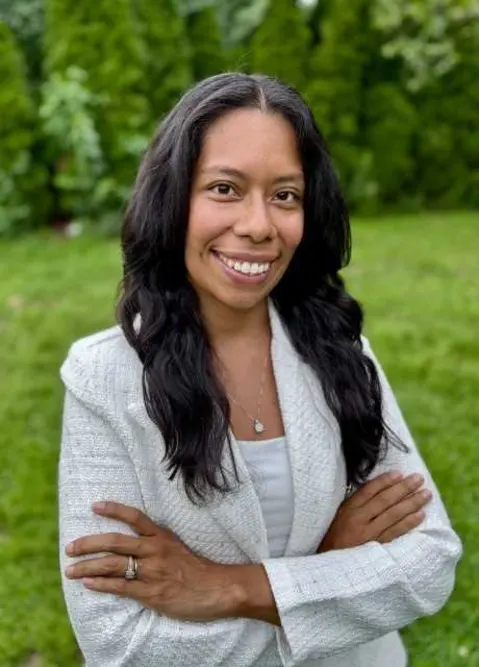
Esmeralda was a non-traditional student in her early 30s when she began working toward a career in education. She has two children and was also working as a nanny when she began her educational journey at Westchester Community College. Esmeralda applied to and was accepted into the WCC and Sarah Lawrence College Transfer Program. This program provides WCC students who are interested in a teaching career a unique opportunity to complete both a Bachelor’s and a Master’s degree in three years upon graduating from WCC. Esmeralda has been described by her Sarah Lawrence Don, Melissa Frazier, as “a remarkable person, who is very focused and at the same time truly open and joyful in her learning”.
Esmeralda Answers Your Questions
What led you to attend and pursue your associates degree at Westchester Community College?
Upon research, I realized Westchester Community College (WCC) would be an ideal starting point for my collegiate journey because it provided affordable tuition and flexible scheduling (evening classes). Due to these factors, I was able to balance a work and college schedule and raise a family.
What sparked your interest in education and wanting to be a teacher?
My passion for teaching stemmed from the lovely teachers I had during my childhood; the love of learning and empathy they afforded me inspired me to do the same for others. However, I discovered my purpose in teaching during adulthood at Westchester Community College (WCC), when I met my professor Rue Beckerman (now Director of SLC’s Art of Teaching program) and learned about Progressive Education.
I remember walking into her classroom and seeing the desks arranged in a circle, a format unfamiliar to me, given that I had attended a traditional public school growing up. Rather than beginning with the traditional lecture, Rue spent the first day getting to know us. This simple act created a profound sense of belonging and respect. I felt valued for who I was and recognized for the experiences and knowledge I brought into the classroom.
As the semester progressed, within that circle, Rue fostered a collaborative environment, where inquiry, dialogue, and shared experiences became central to our learning. I felt free to ask questions without fear of judgment, allowing me to engage more deeply with the nuances of the work. This experience transformed my understanding of education and led me to believe that every child, regardless of race or socioeconomic background, deserves access to a liberatory education.
Tell me about the challenges you faced juggling your responsibilities at home as a mother of two children, working as a nanny and pursuing your degree?
I want to acknowledge that pursuing my degree was a significant financial and family sacrifice, and I would not have been able to achieve my dream of becoming a teacher without the power of community. This journey challenged me in ways I never expected. There were moments when I questioned whether I was spending “enough” time with my children, and there were days when the weight of my responsibilities left me completely exhausted. However, I was never alone. I was blessed with an extraordinary village of professors, family, and friends who afforded me encouragement, love, and unwavering support.
Through the challenges, I learned to let go of some of the guilt I carried as a mother because I understood that pursuing my education and working toward my dreams was not taking away from my children; rather, it provided them with an example of perseverance and courage, and the power of community.
What led you to want to continue your education through the Sarah Lawrence/Westchester Community College Transfer program?
A variety of factors contributed to my final decision to continue my education through the Sarah Lawrence/Westchester Community College Transfer program. Upon learning about the program, I did my research and discovered the unique education SLC provided. For example, SLC focused on the inquiry process across a range of interdisciplinary topics, and this focus on the process rather than finding the correct answer really intrigued me. Additionally, the scholarship would provide relief from college tuition, which would be extremely helpful to me and my family. Still, I was nervous about any hidden costs, the demands of the work, and what that would mean for my family. But the guidance and trust I had in Rue and Diana (a WCC professor) reassured me that there were no hidden fees and that I would have access to academic support if needed.
Talk to us about your experiences at Sarah Lawrence, especially as you transitioned into the Art of Teaching program.
When I transitioned from WCC to SLC, initially it was a cultural shock. The students at WCC are commuters, and most are on campus to attend class and leave, leaving little room to become a close-knit community. Whereas most SLC students live on campus and have a tight-knit community, which can feel uneasy to jump into at first; however, my Don, Melissa Frazier, was a great resource. She connected me with some of her students, who became my friends. She also provided the guidance I needed when I enrolled in courses, guiding me through courses that interested me and would be helpful once I entered the Art of Teaching Program.
Entering the Art of Teaching program was a smooth experience; it felt wonderful to be surrounded by professors and students who honor and respect children for who they are by getting to know them through observation and documentation. Everyone in the program was so willing to help with my professional and personal development.
What mentors did you find at SLC?
Rue has been a guiding light and mentor to me from the beginning of this journey, which continues to unfold! Her wisdom and support have been invaluable to my professional work and to my personal life. I am immensely grateful for the meaningful impact she has had in my life. However, the beauty of the Art of Teaching Program is the sense of family and community it creates. Through this experience, I was able to meet other incredible mentors, including Lorayne Carbon (Director of SLC’s Early Childhood Center) and Emily Cullen-Dunn (Assistant Director of the Art of Teaching program), among many others!
What was your relationship like with other students?
I had a positive experience with other students at SLC. I was fortunate to be part of a cohort that supported each other. I remain friends with most of the cohort, and it is lovely to see each other grow, develop as professionals, and be part of their life milestones.
What advice would you give to someone who is considering pursuing their degree while juggling lots of other responsibilities?
I would tell them not to give up on their academic and personal goals, even when life makes the journey difficult. I know how challenging it can be to keep going when you're facing financial hardship or might not have a strong support system. Still, I would remind them they are not alone. Reaching out to professors, college resources, or fellow students can open doors and provide encouragement along the way. My story is a testament that dreams/goals are not achieved alone; it takes a village. It’s that village that provides support and strength to turn what once felt impossible into something possible.
After graduating, we learned that you are now teaching 1st grade in a high-needs public school in the South Bronx, how are you bringing SLC’s Art of Teaching philosophy and values to that context?
The Art of Teaching program's emphasis on honoring and respecting children for who they are, and on genuinely getting to know them through observation and documentation, has helped me focus on building relationships rooted in trust, respect, and love.
From the moment my students enter my classroom, I make an effort to learn about their strengths, interests, and individuality. I believe that understanding each child allows me to tailor my teaching/curriculum to meet their social-emotional and academic needs. While high-stakes accountability and limited teacher autonomy can sometimes make this challenging, I believe it’s that very connection with my students that has earned me their trust and made learning more joyful, meaningful, and authentic. Overall, I aim to provide an education that allows them to feel safe, embrace who they are, and ask meaningful questions about the world around them. I want my students to learn how to think, not what to think.
You also returned to SLC’s Art of Teaching program and completed the Early Childhood Special Education Advanced Certificate. What made you decide to pursue this credential?
I decided to pursue the Early Childhood Special Education Certificate because of the growing need for Special Education. As a result, I would benefit from having more tools in my practice to meet the needs of my students. I also had a desire to deepen my understanding of inclusive educational practices, rooted in child-centered approaches that valued the individual strengths of neurodivergent students.
What has it been like teaching since leaving the program, and how has this new credential influenced your work?
Since leaving the program, metaphorically speaking, teaching has been a roller coaster. My first year teaching was definitely a challenge, given that I had to learn and adapt to the new responsibilities and culture of a new place. Additionally, I had to take on a general education role in an ICT classroom without a special education teacher, which was quite stressful. There were days that I questioned my every decision and my ability to be a good teacher. But, as with most of my learning journey, I was fortunate to find a safe space with my first-year mentor at my school. She was always so willing to listen to my worries and provided her support when I needed it the most. Moreover, she taught me to be kind to myself.
The additional credential has helped me out tremendously. Even though I am not a special education teacher, I have learned about various child-centered approaches that helped me during my first year of teaching. As a result, I developed a strong relationship with my students irrespective of a label on a paper. Fast forward to my second year of teaching, I had a wonderful co-teacher who embodied many of the beliefs from the Art of Teaching program and was a fierce advocate for children. This experience and credential enabled me to have productive, meaningful conversations about our students that supported their learning.
Have you been able to return to the college and take advantage of the classes and conferences offered through the Saturday Seminars and Child Development Institute to share your work and continue learning?
I am grateful to have been able to return to both the Saturday Seminars and Child Development conferences. Beyond attending, I’ve had the privilege of being invited as a speaker, where I detailed my classroom experiences. On one occasion, I spoke about the value of play, specifically the value of making time for a child-led writing process. A method that required planning, collaboration, taking roles, and developing stories that allowed my students to ask and answer their own and others' questions.
In the end, both spaces have been critical to my continued development. They both provide a valuable and much-needed space to ground ourselves in the face of bureaucratic practices that can sometimes narrow our vision. I believe it is critical to stop, reflect, and connect with others to remain connected with the purpose of our work.